






The Core Question: A Deceptively Simple Idea
Imagine you have a machine that transforms points in space. You put in coordinates (x, y) and get out a new set of coordinates (X, Y) based on a set of polynomial equations—the kind you likely encountered in school. The Jacobian Conjecture, first formally
posed by German mathematician Ott-Heinrich Keller in 1939, asked a fundamental question: If this transformation machine has a very specific property everywhere, can you always reverse it? The property involves something called the Jacobian determinant, a value from calculus that roughly measures how much the transformation stretches or shrinks volume at any given point. The conjecture proposed that if this 'stretch factor' is a non-zero constant everywhere, then the transformation must have a neat polynomial inverse. In simple terms, it asked if being perfectly reversible on a small, local scale guaranteed it was also perfectly reversible on a global scale. Intuitively, the answer feels like it should be 'yes.'
Why It Became a Landmark Problem
The conjecture's importance grew for several reasons. Firstly, it sat at a crossroads of major mathematical fields, including algebraic geometry, calculus, and topology. Solving it was not just about answering one question, but about understanding the deep connections between these areas. Secondly, its statement was understandable with a basic knowledge of calculus, yet its proof was maddeningly elusive. This combination of accessibility and difficulty attracted generations of brilliant minds. The problem was so significant that it was included in mathematician Stephen Smale's 1998 list of the most important mathematical problems for the 21st century. Over the decades, the conjecture became notorious for the sheer number of incorrect proofs submitted, some by very famous mathematicians, earning it a reputation as one of mathematics' greatest traps.
The Search for a Proof or Counterexample
For 87 years, the mathematical community was split. Was the conjecture true, and a fiendishly clever proof was just waiting to be found? Or was it false, and a counterexample—a single transformation that met the conditions but wasn't reversible—was hiding in the infinite landscape of polynomial functions? Many special cases were proven. For example, it was shown to be true for all polynomial transformations of degree 2. It was also proven that if a counterexample existed, one could be constructed with a very specific, simplified form. In two dimensions, the conjecture was verified for polynomials up to degree 100, leading many to believe it was likely true in that specific case, which remains open. However, for three or more dimensions, there was little hard evidence either way, leaving the problem tantalisingly unresolved.
The Surprising End: An AI-Assisted Breakthrough
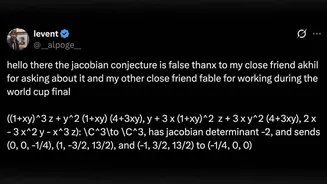
The long-standing question finally met its end in July 2026. Mathematician Levent Alpöge, working with an advanced AI model from Anthropic called Claude Fable 5, discovered a counterexample. Instead of trying to build a complex proof, they hunted for a single function that would break the conjecture. The AI model generated a polynomial map in three-dimensional space that satisfied the conjecture's main condition—its Jacobian determinant was a constant (-2)—but was not invertible. It achieved this by mapping three different input points to the exact same output point, making a perfect reversal impossible. The counterexample was short enough to be shared in a social media post and could be quickly verified by other mathematicians and computer systems, confirming that the 87-year-old conjecture was, in fact, false for dimensions of three and higher.