




The Final Hurdle Before Flight
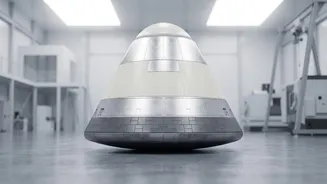
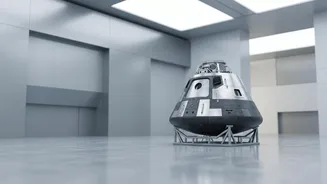
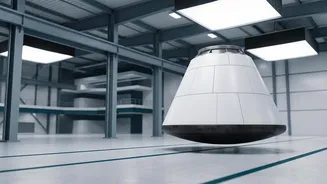
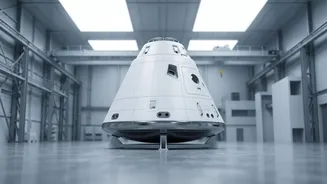
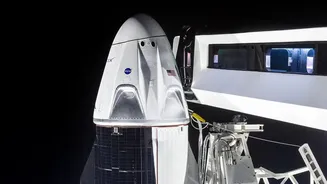
Before Indian astronauts, or 'Vyomanauts', can journey into orbit, the capsule they will call home must be proven to be unequivocally safe. This capsule, known as the Crew Module, is the only part of the massive rocket that returns to Earth. Therefore,
its structural integrity and safety systems are paramount. ISRO has recently completed a crucial trio of qualification tests designed to validate the module's performance during some of the most perilous phases of its journey: post-splashdown recovery, separation from its support module, and enduring the violent forces of parachute deployment. These aren't just items on a checklist; they represent an integrated approach, ensuring all systems work together flawlessly under extreme stress, providing a new level of confidence in the capsule's design.
Test 1: Ensuring a Safe Splashdown
A successful mission ends with a gentle splashdown in the ocean. But what if the capsule lands upside down? The first of the three tests, the Float Inflation Test for the Crew Module Up-righting System (CMUS), tackled this exact scenario. This system is one of the most important crew safety requirements. It uses a stored, cold-gas system to rapidly inflate flotation bags. These bags act like a self-righting mechanism, ensuring the capsule turns upright in the water so the crew can be safely recovered. The successful tests demonstrated that the inflation system works within the required time across a full range of operating pressures, confirming that astronauts won't be left in a dangerous position upon their return.
Test 2: A Clean Break Before Re-entry
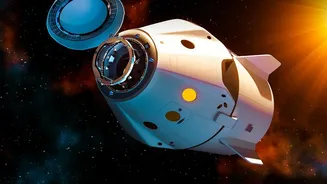
Before the Crew Module can re-enter Earth's atmosphere, it must cleanly separate from the Service Module, which provides power and propulsion in orbit. The connection, a complex umbilical carrying electrical and fluid lines, must sever perfectly. A snag could be disastrous. The second test focused on this Umbilical Separation System. Specifically, it validated the separation of the part of the umbilical attached to the Crew Module (CSU-2) just before re-entry. The test demonstrated a clean break and, crucially, confirmed the structural stability of the panel where the umbilical is attached, ensuring the module's integrity isn't compromised during this critical event.
Test 3: Surviving the Shock of Deceleration
To slow the capsule from hypersonic speeds, a sequence of parachutes must deploy. This process begins with the explosive, pyrotechnic jettisoning of the Apex Cover, which protects the parachute compartment during ascent and re-entry. The third qualification test was designed to prove the Crew Module's structure can withstand the immense shock and load from this event. In the test, engineers applied forces approximately 1.75 times greater than the estimated loads the module will actually face during a mission. By measuring the strain and deformation, ISRO confirmed that the design has sufficient margins and that the capsule's structural integrity remains solid, ensuring the parachute deployment sequence starts without damaging the very vehicle it's trying to save.
Building a Fortress for India's Astronauts
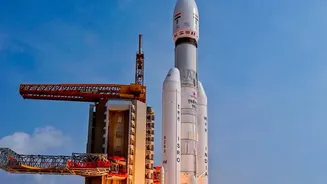
While these three ground-based tests are pivotal, they are part of a much larger, multi-faceted safety campaign. This includes a series of high-altitude abort tests, like the successful TV-D1 mission, which prove the Crew Escape System can pull the capsule and its crew away from a failing rocket during launch. It also involves extensive parachute testing, including Integrated Air Drop Tests where a full-scale module is dropped from an aircraft to validate the entire deceleration and splashdown sequence. Each test, whether on the ground or in the air, layers on another level of safety. The context offered by this recent three-test push is one of meticulous, methodical validation, where every potential failure point is scrutinized and every system is tested not just in isolation, but as part of an integrated whole. This exhaustive process is the bedrock upon which the safety and success of India's first human spaceflight will be built.