


A Glimpse Into Cosmic Dawn
The galaxy in question, known as J0148-4214, is extraordinarily remote. Its light has travelled for over 12.5 billion years to reach us, meaning we are seeing it as it existed just 1.2 billion years after the Big Bang. This makes it a priceless window
into a period known as 'cosmic dawn', when the first stars and galaxies were forming. While most large galaxies, including our own Milky Way, have a single supermassive black hole at their core, finding three in one galaxy from this era is exceptional. An international team led by the Max Planck Institute for Extraterrestrial Physics made the discovery, calling it the first evidence of a triple active black hole system in the distant universe.
How to Spot an Invisible Giant
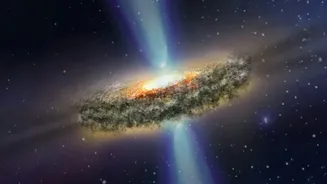
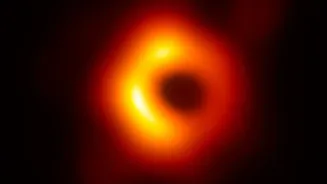
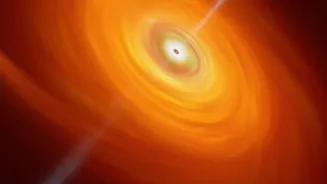
Black holes themselves are invisible, so astronomers must hunt for them indirectly. The team used the James Webb Space Telescope's powerful Near-Infrared Spectrograph (NIRSpec). This instrument acts like a prism, splitting light from the galaxy into a spectrum. They focused on the light emitted by hydrogen gas, which gets whipped into a frenzy by the immense gravity of a nearby 'actively feeding' black hole—one that is voraciously consuming surrounding matter. This high-speed motion stretches the light waves, a phenomenon called a 'broad line' emission. The spectrum from J0148-4214 was unusually complex, suggesting not one, but three distinct regions of rapidly moving gas, each signalling the presence of a massive black hole.
A Tale of Three Black Holes
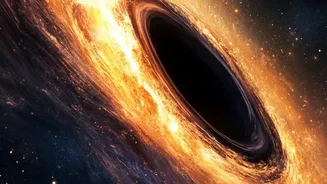
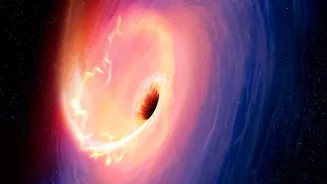
Analysis revealed a fascinating hierarchy within the cosmic trio. Two of the black holes are huddled close together in the galaxy's centre, separated by only about 620 light-years—a tiny distance in cosmic terms. One of these is a behemoth, weighing in at around 80 million times the mass of our sun. Its close companion is a relative lightweight at 600,000 solar masses, but it appears to be growing ferociously, feeding on gas at a rate that may exceed theoretical limits. The third black hole, with a mass of about two million suns, lies further out, around 5,500 light-years from the central pair.
The Legacy of Galactic Mergers
So how did three massive black holes end up in the same place? The leading theory is that this system is the result of multiple galaxy mergers. In the chaotic early universe, galaxies frequently collided and combined. As they did, their central black holes would have sunk toward the centre of the newly formed, larger galaxy. The J0148-4214 system provides a stunning snapshot of this process in action. It suggests that such mergers were an efficient way for black holes to grow so massive, so quickly after the Big Bang, a long-standing puzzle in astronomy. The central pair are on a collision course and are expected to merge themselves within a few hundred million years.
A New Era of Discovery
This discovery is more than just a cosmic curiosity; it changes how astronomers will search for these objects. Without the incredible spatial resolution of the NIRSpec instrument, the complex light signal would have been blended together, and researchers would likely have identified only one of the three black holes. This implies that other distant galaxies with similarly complex signals could also be hiding multiple black holes. Finding more systems like J0148-4214 will help clarify how often these galactic pile-ups occurred. Furthermore, the eventual merger of these black holes would release a tremendous burst of gravitational waves, the kind that future space-based observatories are being designed to detect.