









The Birth of the Supercar
To understand the legend, you first have to understand the car it came from: the Lamborghini Miura. Unveiled as a rolling chassis in 1965 and as a complete car in 1966, the Miura changed everything. With its engine placed in the middle, just behind the driver,
it established the template for nearly every high-performance supercar that followed. It was a radical departure from the front-engined grand tourers of the era, a stunningly beautiful and shockingly fast machine that put the young Lamborghini company on the map. But for one of the company's engineers, the standard Miura was just the starting point. He had a vision for something even more extreme.
The Secret 'Jota' Project
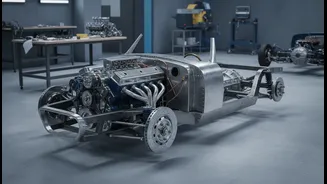
That engineer was Bob Wallace, Lamborghini’s legendary chief test driver. Working after hours and on weekends in the early 1970s, he took a Miura chassis and began a secret project to create the ultimate performance version, one that could, in theory, go racing. He called it the 'Jota,' a name derived from the Spanish pronunciation of the letter 'J,' which referenced the FIA's Appendix J racing regulations. Wallace re-engineered the car from the ground up, using lightweight aircraft-grade aluminum alloys to construct a new frame and body, stripping out the interior, and tuning the V12 engine to produce well over 400 horsepower. The Jota was a skunkworks masterpiece—a raw, aggressive, one-of-one test bed for ideas too radical for production.
A Fiery End and a Rising Myth
After thousands of miles of intense testing by Wallace, Lamborghini, facing financial pressures, sold the Jota in 1972. Its new life was tragically short. Soon after the sale, a mechanic crashed the priceless prototype, and the car burned to the ground, a total loss. But its destruction is precisely what cemented its status as a legend. News of the secret supercar and its fiery demise created a myth. Wealthy clients, captivated by the story, began requesting their own Jota-inspired cars. In response, the factory built a handful of Miuras modified with Jota-style aerodynamics and performance upgrades, known as the SVJ. But these were not true Jotas; the original was gone forever, its full potential an unfinished symphony.
Automotive Archaeology at Polo Storico
For decades, the story ended there. But in the modern era, Lamborghini established a division with an almost impossible mission: to preserve and resurrect its past. This is Polo Storico, the brand's official heritage and restoration department. Part archive, part workshop, and part historical detective agency, its team of experts meticulously restores and certifies classic Lamborghinis. Crucially, they have the ability to do more than just restore. Using original design documents, technical drawings, and period photographs, they can completely reconstruct a vehicle that no longer exists. They proved this by rebuilding the long-lost 1971 Countach LP500 prototype from scratch, a project that took thousands of hours.
Finished at Last in 2026
That same dedication to authenticity is what makes the 2026 completion of the Jota project possible. In a landmark undertaking by Polo Storico, the ultimate Miura is being reborn. This is not a restomod or a modern interpretation; it is a perfect recreation, an act of automotive archaeology intended to finish what Bob Wallace started. Using the same materials and techniques, and guided by the trove of information in the company's archives, Lamborghini is building the car that was lost. This 2026 collector car is the embodiment of the original Jota, a direct link to a pivotal moment in the brand's history, finally completed more than 50 years after its untimely end. It represents the ultimate collector's item: a ghost made real.