


A Galaxy with a Secret History
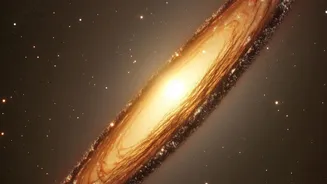
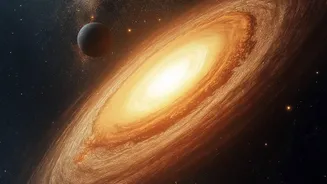
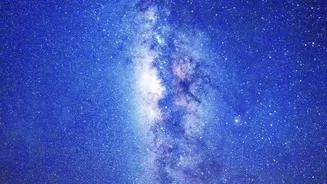
When we picture the Milky Way, we imagine a vast, flat disc of stars, gas, and dust, spinning elegantly through space. This disc is where our solar system resides. But surrounding this familiar structure is a faint, spherical cloud of ancient stars called
the stellar halo. For years, astronomers have been puzzled by this halo; its stars rotate around the galactic centre far more slowly than the stars in the disc. New research presented in July 2026 suggests this strange behaviour is a clue to a dramatic and violent event in our galaxy's youth.
What is a Galactic Disc Flip?
The term "disc flip" sounds like the entire galaxy did a cosmic somersault. The reality is both more complex and more fascinating. It describes a slow, dramatic reorientation of the main stellar disc by more than 90 degrees. This wasn't an instantaneous event but a gradual process that likely took hundreds of millions of years to unfold, driven by immense gravitational forces. According to new simulations by astronomers at Durham University, such a flip would have completely changed the orbital paths of most of the stars in the galaxy, including, potentially, our own Sun.
The Prime Suspect: A Galactic Collision
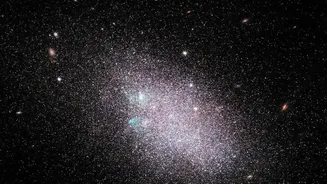
What could exert enough force to tip an entire galaxy's disc? The leading theory points to a massive, head-on collision with a smaller galaxy. The prime suspect is a dwarf galaxy known as Gaia-Sausage-Enceladus, so-named because its stars were discovered moving in elongated, sausage-shaped orbits. This collision, which occurred roughly 10 billion years ago, was a defining moment in the Milky Way's history. Our larger galaxy tore the interloper apart and absorbed its stars, but the chaotic event sent shockwaves that fundamentally reshaped our home.
New Evidence from Supercomputers
This is where the new computer simulations come in. Researchers at Durham University ran sophisticated models of galaxy evolution to solve the mystery of the slowly rotating stellar halo. They found that simulated galaxies that experienced a major head-on collision, much like the one with Gaia-Sausage-Enceladus, were also highly likely to have undergone a disc flip. These simulations successfully recreated the slow halo rotation seen in our own galaxy, creating a powerful link between the ancient collision, the disc flip, and the stellar motions we observe today.
Reading the Clues in the Stars
Astronomers act as cosmic detectives, piecing together the past from clues left behind in the present. The motion of stars in the halo serves as a fossil record of ancient events. By observing these movements with instruments like the European Space Agency's Gaia mission, scientists can test their computer models. The fact that the simulations accurately predict the slow halo rotation provides strong support for the disc flip hypothesis. Lead researcher Kirill Batrakov noted that what excites him most is that this complex history can be reconstructed just from present-day observations.
Why This Cosmic History Matters
Understanding this violent chapter in our galaxy's past does more than just solve a long-standing puzzle. It refines our models of how all spiral galaxies form and evolve. These collisions and subsequent reorientations appear to be a key, if chaotic, part of galactic maturation. Furthermore, these ancient impacts have been linked to triggering major episodes of star formation. While it cannot be proven definitively, it is possible that the collision with the Sagittarius dwarf galaxy, another galactic merger, may have created the conditions necessary for our own Sun and solar system to form.