




The Doomsday Glacier Explained
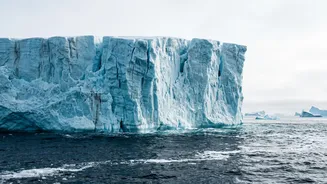
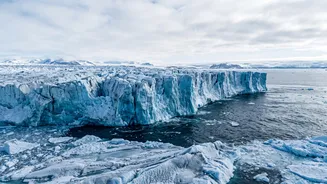
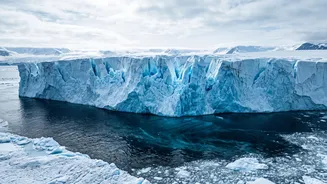
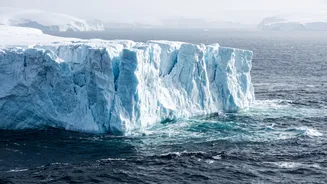
Roughly the size of Florida or Great Britain, the Thwaites Glacier is one of the largest and fastest-melting glaciers on Earth. It acts like a massive cork, holding back the rest of the West Antarctic Ice Sheet, which itself contains enough ice to raise
seas by an additional 10 feet. Its rapid retreat over the past few decades is a major concern for scientists, as its melt currently contributes about 4% of the annual global sea-level rise. The glacier sits on a bed that slopes downward, meaning that as it melts and its grounding line—the point where the ice lifts off the seabed and begins to float—retreats, ever more ice is exposed to the relatively warm ocean water that is eating it away from below.
What the Latest Science Reveals
Recent studies have dramatically sharpened our understanding of Thwaites' decline. A study published in 'Nature Communications' in October 2026 used a new, more sophisticated ice-sheet model. It revealed that warm seawater is penetrating several kilometres farther under the glacier than previously thought, a process accelerated by the daily tides. This enhanced melting at the 'grounding zone' means the glacier's contribution to sea-level rise could reach 1.2 inches (30 millimetres) by 2100, a figure that doubles previous estimates, even without any further increase in global warming.
A Future Locked In?
Another alarming study from the British Antarctic Survey (BAS) found that the glacier's retreat may now be unavoidable for a long time. Using computer simulations, researchers found that even if the ocean warming driving the melt were to be completely switched off—an impossible real-world scenario—Thwaites would continue to lose ice for at least the next 150 years. This suggests that the melting that began in the 1940s has pushed the glacier into a state of committed retreat. This doesn't mean we are helpless. While some future ice loss from Thwaites is now locked in, the rate and extent of that loss can still be significantly worsened by ongoing greenhouse gas emissions.
The Race to Understand
Understanding what is happening at Thwaites is one of the most urgent tasks in climate science. It is an incredibly remote and hostile environment, which is why major international efforts like the International Thwaites Glacier Collaboration are deploying every tool available, from ice-breaking ships to underwater robots, to get a clearer picture. The new models are also concerned with underwater ridges that act as pinning points, holding the glacier back. One such feature, the Mouginot Ridge, has a 60% chance of becoming unpinned from the glacier by 2100, which could rapidly accelerate its flow into the ocean. These detailed insights are critical for coastal communities around the world, including in India, to prepare for the rising seas of the coming decades.