

What 'Greatest Elongation' Means for Sky-Watchers
On August 15, 2026, Venus will reach what astronomers call its greatest eastern elongation. In simple terms, this is the point in its orbit where it appears farthest from the Sun in our sky. Because Venus orbits closer to the Sun than Earth does, it's
always seen in the same general direction as the Sun, either trailing it at sunset or preceding it at sunrise. This 'greatest elongation' is the peak of its visibility as an evening object, when it hangs in the twilight sky for the longest duration after the Sun has gone down. For anyone looking for an easy and rewarding stargazing target, this is the perfect time to step outside, as Venus will be at its most prominent in the evening sky.
The Dazzling 'Evening Star' Explained
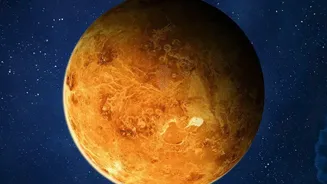
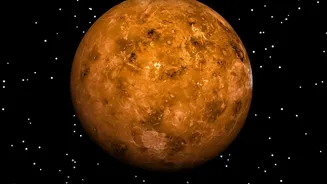
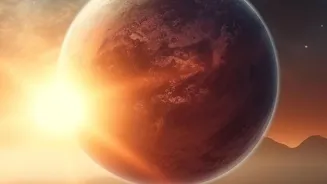
For centuries, people have called Venus the 'Evening Star' or 'Morning Star', sometimes mistaking it for two different celestial bodies. It's easy to see why. Venus is, after the Moon, the brightest natural object in the night sky. Its incredible brightness isn't because it produces its own light, but for three key reasons. First, it's our closest planetary neighbour. Second, it's a relatively large inner planet. And third, its surface is completely shrouded in thick, highly reflective clouds that bounce about 77% of the sunlight that hits them back into space. This combination makes Venus an unmistakably brilliant beacon, easily cutting through the evening twilight.
How to Spot Venus on August 15
Spotting Venus requires no special equipment or expertise. On and around August 15, simply look toward the western sky shortly after sunset. You can't miss it: it will appear as a remarkably bright, steady point of light shining through the fading daylight. Unlike stars, which twinkle, Venus’s light will be constant and unwavering. For the best view, find a location with an unobstructed view of the western horizon, away from tall buildings or trees. While it will be easily visible to the naked eye, if you have a pair of binoculars or a small telescope, you may be able to observe its phase. Around its greatest elongation, Venus appears about half-illuminated, resembling a tiny quarter Moon. On August 15 and 16, a thin crescent Moon will also appear near Venus, creating a beautiful pairing in the sky.
A Perfect Gateway to Amateur Astronomy
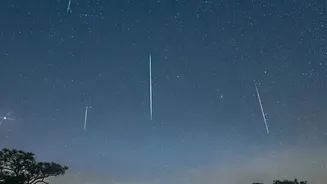
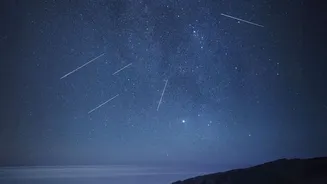
Celestial events like this are a fantastic entry point for anyone curious about the night sky. The Venus elongation requires no expensive gear and is accessible even from brightly lit urban areas, though a darker site always enhances the experience. It serves as a great opportunity for families to share a moment of wonder and for individuals to connect with the cosmos in a tangible way. The event also falls just after the peak of the annual Perseid meteor shower on August 12-13, making it a particularly rich week for sky-watching. The dark, moonless skies ideal for the Perseids will give way to a lovely crescent Moon appearing near Venus just a couple of days later. This simple act of looking up and identifying our planetary neighbour is a timeless human activity that reminds us of our place in the solar system.