






The Making of an Astronaut
Born in Minneapolis, Minnesota, to immigrants from India and Ukraine, Anil Menon’s path to the stars was paved with a unique blend of academic brilliance and rugged, real-world experience. His journey began not with a singular focus on space, but with a deep-seated
curiosity about the human body and engineering. After earning a degree in neurobiology from Harvard University, he spent a year in India as a Rotary Ambassadorial Scholar, contributing to polio vaccination efforts. This was followed by a formidable academic run at Stanford University, where he secured a master's in mechanical engineering and a doctorate in medicine. This dual expertise in how things work and how bodies function would become the hallmark of his distinguished career.
A Career Defined by Service
Before he ever wore a NASA patch, Menon’s life was one of service in some of the world's most challenging environments. As an emergency medicine physician, he was a first responder at the sites of the 2010 earthquake in Haiti and the 2015 earthquake in Nepal. His military career is just as decorated; as a flight surgeon in the U.S. Air Force, he flew over 100 sorties in an F-15 fighter jet and deployed to Afghanistan during Operation Enduring Freedom. Now a Colonel in the U.S. Space Force, his transition reflects the deep and ongoing collaboration between the military and America's civilian space program. His experience extends to the highest peaks on Earth, having worked with the Himalayan Rescue Association to care for climbers on Mount Everest.
From SpaceX Pioneer to NASA Astronaut
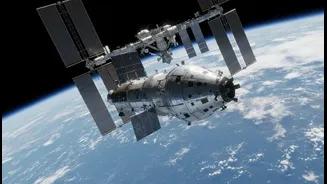
Menon’s direct involvement with human spaceflight began in 2014 as a NASA flight surgeon, where he supported astronauts on long-duration missions to the International Space Station. He then made history at SpaceX in 2018, becoming the company's first-ever flight surgeon. In this role, he was instrumental in building its medical program from the ground up and supported the launch of its first human missions, including the landmark Demo-2 flight. In December 2021, his lifelong dream was realized when he was selected to join NASA's astronaut corps. After two years of intensive training, he was assigned to his first spaceflight, a testament to his vast and varied skill set.
An Eight-Month Mission in Orbit
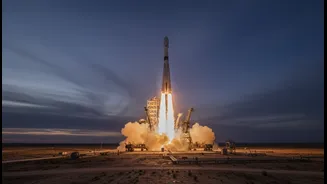
Launched on July 14, 2026, aboard a Russian Soyuz spacecraft, Menon's mission is an ambitious one. While a typical stint on the ISS lasts about six months, his assignment is scheduled for approximately eight months, making it a significant endurance test. As a flight engineer, he will be responsible for station maintenance, spacewalks, and operating robotic systems. His medical background will also be put to use as he serves as a crew medical officer. A significant portion of his time will be dedicated to cutting-edge science. His experiments will include studying the effects of microgravity on the human body, testing technology to produce IV fluids from the station's water supply, and refining the in-space production of semiconductor crystals—research that holds promise for both deep-space exploration and life on Earth.
A Beacon for Billions
Menon's journey from Minneapolis to the ISS, via Baikonur, is a powerful story of international cooperation. Launching from the same Kazakh spaceport where Yuri Gagarin became the first human in space, aboard a Russian vehicle with Russian crewmates, his mission underscores the global nature of space exploration. For many in India and across the diaspora, his achievement is a source of immense pride. His career, which has bridged medicine, military service, and space exploration, serves as a powerful inspiration. He is not just an astronaut; he is a physician, a veteran, and the son of immigrants who has reached for the stars and now lives among them, carrying the aspirations of many with him.