


The Fabric of Reality
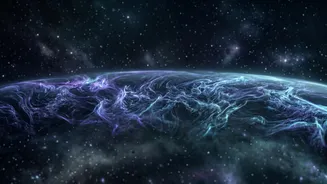
At the heart of modern physics lie two incredibly successful, yet fundamentally incompatible, theories. Einstein's theory of general relativity describes a large-scale universe where gravity is the result of massive objects warping a smooth, continuous
fabric of spacetime. It works perfectly for planets, stars, and galaxies. On the other hand, quantum mechanics describes the microscopic world of particles, where everything is chunky, probabilistic, and quantized into discrete packets of energy. The quest to unite these two ideas into a single 'theory of everything' is one of the biggest challenges in science, and it leads to a fascinating question: what does spacetime look like at the tiniest possible level? Many theories of quantum gravity predict that if you could zoom in far enough, spacetime would stop being smooth and would instead resemble a turbulent, bubbling 'quantum foam' of tiny, distinct units, much like a digital image is made of pixels.
Cosmic Messengers as Probes
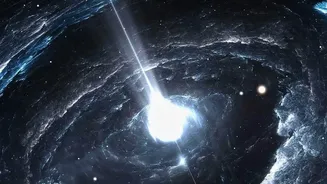
Testing this idea is nearly impossible in a lab. The predicted 'pixels' of spacetime would be on the order of the Planck length, about 10^-35 metres, a scale trillions of times smaller than an electron. Fortunately, the universe provides a natural laboratory. Extremely distant and violent events, like gamma-ray bursts (GRBs), act as powerful flashlights. These bursts, often caused by the death of massive stars, send high-energy photons hurtling across the cosmos for billions of years. The key idea is that if spacetime is 'foamy' or grainy, it should affect how light travels. Photons with very high energy (and thus very short wavelengths) would interact with the tiny bumps in spacetime more than lower-energy photons. This should cause them to slow down ever so slightly over their immense journey. By the time the light reaches our telescopes, there should be a measurable delay between the arrival of high-energy photons and low-energy photons from the same burst.
A Universe Without Grain
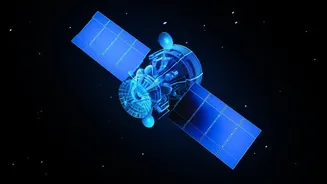
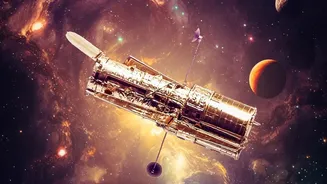
Scientists have used powerful instruments, like NASA's Fermi Gamma-ray Space Telescope, to search for this tell-tale delay. In one key observation, Fermi detected two photons from a gamma-ray burst that had travelled for over 7 billion years. One photon had a million times more energy than the other. Yet despite their vast journey and huge energy difference, they arrived at the detector less than a second apart. This result, and others like it from different observatories and cosmic sources, has found no evidence of the expected delay. The light from the early universe shows up crisp and clear, with photons of all energies arriving essentially at the same time. This suggests that if spacetime has any graininess at all, it must be on a scale far smaller than many prominent quantum gravity models predicted. For all intents and purposes, spacetime appears to be perfectly smooth.
A 'Beautiful Failure' for Physics
Finding nothing can be just as important as finding something. The lack of evidence for spacetime graininess has profound implications. It effectively rules out or places severe constraints on some of the simpler models proposed for quantum gravity. Theories that predicted a relatively large 'pixel' size for spacetime are now in jeopardy. However, this doesn't mean the quest for quantum gravity is over. It simply forces physicists to get more creative. Some theories, like certain versions of string theory, already predicted a smooth spacetime. Others, like Loop Quantum Gravity, suggest the graininess might manifest in a more subtle way that doesn't affect the speed of light. The search for this fundamental texture of reality has narrowed, pushing scientists to refine their ideas and design new kinds of experiments to test the unification of our two greatest theories of the cosmos.