






Why Your Back Aches at Your Desk
Prolonged sitting is a primary culprit behind common aches and pains. When you sit for hours, especially with poor posture, your core muscles can disengage, hip flexors tighten, and your spine compresses under the weight of being hunched forward. This
combination puts significant strain on the muscles and ligaments in your back, leading to stiffness, discomfort, and chronic pain. The solution isn't necessarily more intense exercise, but more frequent movement. Short, intentional 'micro-breaks' for stretching can counteract the negative effects of a sedentary position, increase blood flow, and reduce muscle fatigue.
1. Seated Cat-Cow
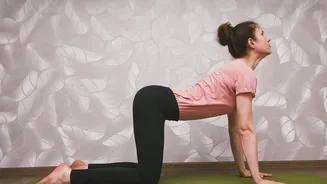
This classic yoga movement is excellent for improving spinal flexibility and relieving tension in the back and neck. It can be easily adapted for your office chair. Sit tall at the edge of your chair with both feet flat on the floor and your hands on your knees. On an inhale, gently arch your back, push your chest forward, and look up toward the ceiling (Cow pose). As you exhale, round your spine, tuck your chin to your chest, and gently pull your navel in (Cat pose). Flow between these two positions for 5-8 breaths, synchronizing the movement with your breathing to gently awaken your spine.
2. Seated Spinal Twist
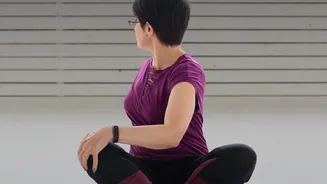
A gentle twist can help decompress your vertebrae and release tightness in your lower back and obliques. Sit tall in your chair with your feet flat on the floor. Inhale to lengthen your spine. As you exhale, gently twist your torso to the right, placing your left hand on your right knee and your right hand on the back or armrest of the chair to deepen the stretch. Hold for three deep breaths, making sure to twist from your mid-back, not just your neck. Return to the center and repeat on the left side. This movement also aids digestion, making it a great post-lunch reset.
3. Desk Upward-Facing Dog
This modification helps counteract the forward hunch that’s common for desk workers by opening up the chest and shoulders. Stand up and face your desk. Place your hands on the edge of the desk, about shoulder-width apart. Step your feet back until your body forms a straight line from your head to your heels, similar to a plank position. Gently press your hips forward and down toward the desk, lift your chest, and look forward. Keep your shoulders rolled back and down, away from your ears. You should feel a stretch across your chest and the front of your body. Hold for 15-20 seconds.
4. Chair Pigeon Pose
Tight hips can contribute significantly to lower back pain. This seated stretch targets the hip rotators and glutes. While sitting in your chair, cross your right ankle over your left knee, keeping your right foot flexed to protect the knee. Sit up straight, and if you feel a good stretch, stay here. To deepen it, gently hinge forward at your hips, keeping your spine long, until you feel a moderate stretch in your right glute and hip. Hold for 20-30 seconds, breathing deeply, then switch to the other side.
5. Neck and Shoulder Rolls
We often hold a surprising amount of tension in our neck and shoulders while concentrating or typing. Releasing this is simple. While seated, gently drop your chin to your chest and slowly roll your right ear toward your right shoulder. Hold for a moment before rolling back to the center and over to the left side. Repeat this 3-5 times. Afterwards, inhale and lift your shoulders up toward your ears, then exhale and let them drop completely. These small movements can prevent tension from building into a headache.