


The Giant-Impact Hypothesis
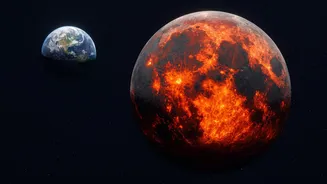
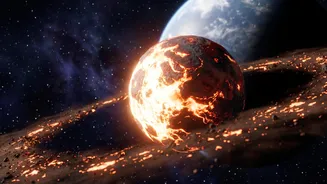
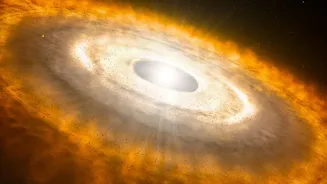
For decades, the most widely accepted explanation for the Moon's existence has been the Giant-Impact Hypothesis. The story goes that about 4.5 billion years ago, our solar system was a chaotic place. A young, still-forming Earth was struck by a Mars-sized
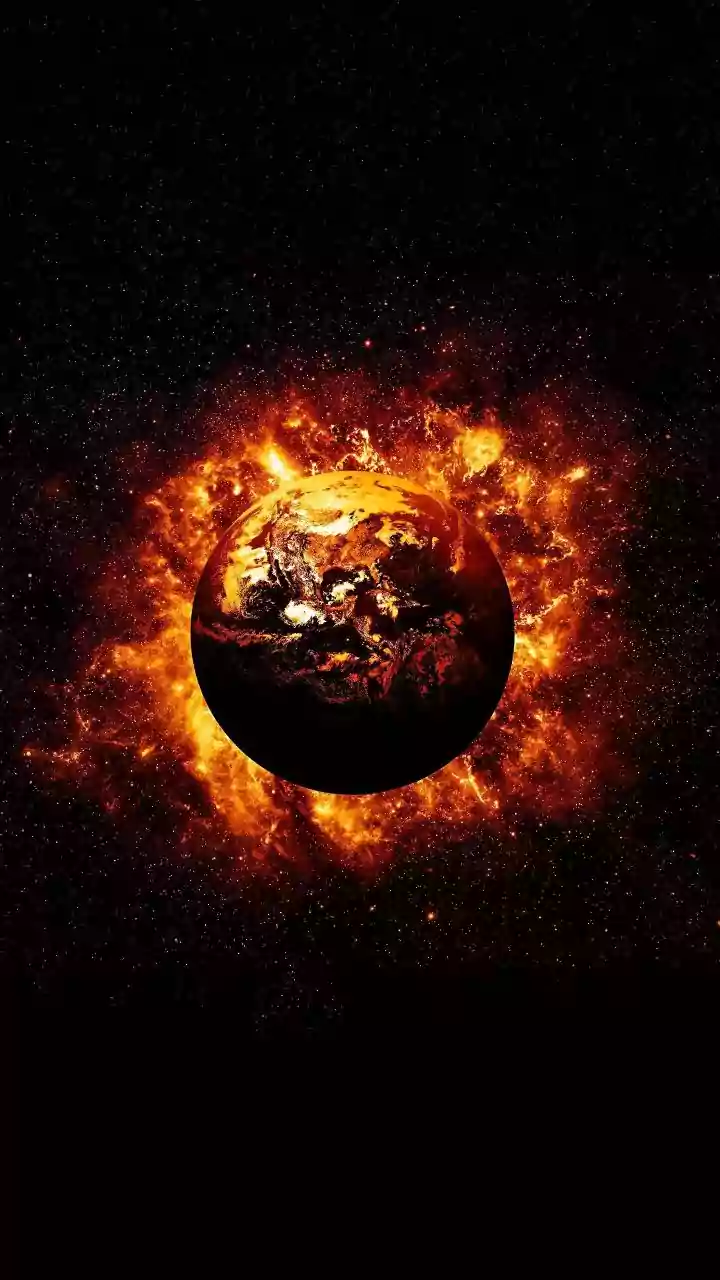
protoplanet that scientists have named Theia. The cataclysmic impact was not a direct hit but a glancing blow, which sent a colossal amount of vaporized rock and debris into orbit around Earth. Over time, this ring of material is thought to have coalesced under its own gravity, eventually forming the Moon we see today. This theory neatly explains several key features, such as the Moon's relatively small iron core and why it was once molten.
A Lingering Isotopic Puzzle
Despite its success, the standard Giant-Impact Hypothesis has a major flaw that has long puzzled scientists. If the Moon is mostly made from the remains of Theia, its chemical makeup should be distinct from Earth's. Every planetary body in the solar system has a unique isotopic signature, like a chemical fingerprint. However, analysis of lunar rocks brought back by the Apollo missions showed that the Moon and Earth are startlingly similar in their isotopic composition. This finding presents a paradox: computer simulations of the impact often show that the debris disk should be formed from 80% of Theia's material, yet the evidence on the Moon suggests it's a near-perfect twin of Earth.
The Strength of Worlds
New research from scientists at the Southwest Research Institute and the University of Arizona offers a compelling solution by adding a previously overlooked factor to their simulations: material strength. For years, models of the giant impact treated the proto-Earth and Theia as if they were fluids, assuming the energy of the collision was so immense that the physical strength of their rock and metal wouldn't matter. However, a recent study published in The Astrophysical Journal Letters incorporated the temperature-dependent strength of the colliding bodies. Just like on Earth, colder rock is stronger and more resistant to deformation, while hotter rock is weaker. Researchers wondered if this property, which is crucial for understanding smaller asteroid collisions, would make a difference on a planetary scale. It turned out to matter a great deal.
Simulating a New Scenario
By running advanced smoothed-particle hydrodynamics simulations, the researchers discovered that the pre-impact temperature and strength of Theia could fundamentally change the outcome of the collision. When they simulated a colder, stronger Theia, the result was similar to older models—a drawn-out process where a debris disk gradually forms the Moon. But when they modeled a hotter, weaker Theia, something dramatically different happened. Instead of simply disintegrating, the impact caused large, intact chunks of Theia's mantle to be thrown into orbit. In some simulations, this process happened astoundingly fast, placing a massive, largely intact proto-moon into orbit within hours of the initial collision, rather than the centuries or millennia previously thought.
What This Means for the Moon's Story
This rapid, 'intact-moon' scenario provides a fresh perspective on the Moon's formation. It suggests that our satellite might not have been slowly built from a diffuse ring of debris, but could have started as a single large body captured in orbit almost immediately after the impact. This pathway has significant implications. For one, it could help constrain the timing of the collision. Protoplanets were hotter earlier in the solar system's history and cooled over time. A hotter Theia suggests the Moon-forming event may have occurred very early, perhaps less than 60 million years after the solar system's birth. Furthermore, a faster and more violent formation process could offer new ways to explain the isotopic similarities between Earth and the Moon, a key puzzle this new research helps to address.