







More Than a Daily Ceremony
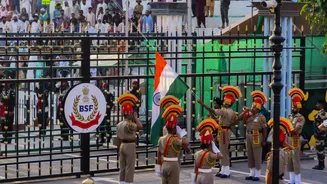
While the synchronised flag-lowering ceremony has been a daily military tradition since 1959, the Attari border is also home to a critical piece of national infrastructure: the Integrated Check Post (ICP). Inaugurated in 2012, the ICP at Attari was designed
to be a bustling hub for trade and travel between India and Pakistan. It represents the only land port on the nearly 3,000-kilometre border equipped to handle both cargo and passengers, consolidating customs, immigration, and security services into a single, streamlined facility. This dual identity—a site of symbolic rivalry and a gateway for economic exchange—makes Attari a unique barometer of the complex relationship between the two nations. The daily ceremony draws thousands, but the silent cargo terminals tell a deeper story of potential and paralysis.
The Scale of Ambition: A Rs 150 Crore Facility
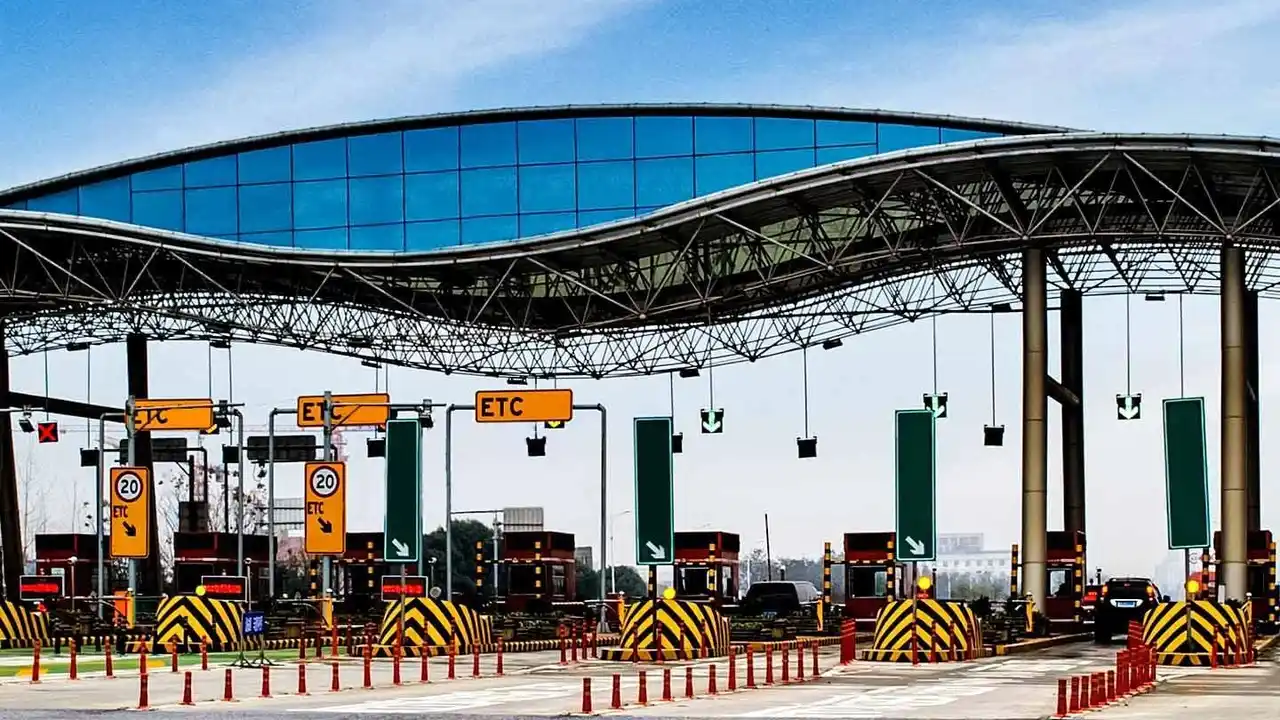
The ICP at Attari is a testament to an ambition for greater regional trade. Built at a cost of approximately Rs 150 crore, the facility sprawls across 120 acres. It was engineered to transform cross-border logistics, featuring dedicated passenger and cargo terminals, 16 immigration counters, multiple customs desks, and vast warehouses for imports and exports. The infrastructure includes a parking area for trucks spanning 55,000 square metres and advanced security systems like X-ray baggage scanners and CCTV surveillance. At its peak, the trade flowing through this land port was valued at over Rs 4,000 crore annually, serving not just bilateral commerce with Pakistan but also acting as a vital transit route for goods, especially dry fruits, from Afghanistan. This massive scale was intended to support a tenfold increase in trade, a vision that has since been overshadowed by political realities.
Current Status: A Gateway Largely Shut
As of August 2026, the Attari ICP operates in a state of deep suspension for most bilateral trade with Pakistan. Commerce was severely curtailed in 2019 after the Pulwama attack, when India imposed 200% customs duties on Pakistani goods. Pakistan subsequently suspended all trade ties following India's constitutional changes in Jammu and Kashmir. The border was further closed for a period in 2025 following another terror attack, halting almost all movement. While the border remains a designated crossing, and was recently opened for foreign e-visa holders (excluding Pakistani nationals), its primary commercial function is dormant. The main activity now is the limited transit of goods from Afghanistan, which itself has faced disruptions, leaving the state-of-the-art facility largely underutilised.
The Wider Context: Geopolitics at the Gate
The operational status of the Attari border is inextricably linked to the volatile state of India-Pakistan relations. Key geopolitical events have consistently led to its closure or the suspension of trade, turning the ICP into a tool of statecraft. The 2019 Pulwama attack and the 2025 Pahalgam attack are two major recent examples where security concerns led to immediate economic retaliation at the border. This has created a challenging environment where the infrastructure for peace and commerce is held hostage by conflict and mistrust. Consequently, a significant amount of unofficial trade between the nations is rerouted through third countries like the UAE, highlighting a demand that formal channels can no longer meet. The government maintains that any decision to resume trade will be based on national security considerations, leaving the future of the port contingent on diplomatic breakthroughs.
The Human and Economic Cost
The suspension of trade has had a severe impact on the local economy of Punjab and the livelihoods of thousands. An entire ecosystem of traders, transporters, porters, and logistics workers that depended on cross-border commerce has been left unemployed. Before the downturn, the port handled key commodities: India exported items like vegetables and plastic granules, while importing cement, rock salt, and dry fruits from Pakistan. Business leaders in Amritsar have repeatedly called for the reopening of the border, pointing out that trade with Pakistan continues through sea ports via Dubai, while the most direct land route remains choked. The closure not only affects bilateral trade but also hurts Afghanistan's access to the vast Indian market, disrupting its key exports and stranding transporters for weeks at a time during closures.