


A New Look at Our Star
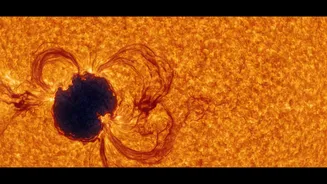
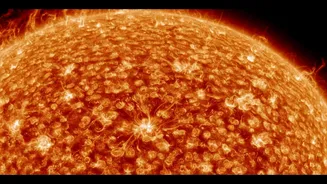
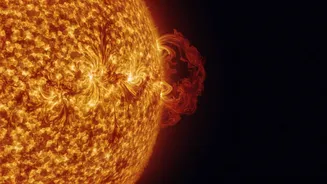
The images, captured by the National Science Foundation's Daniel K. Inouye Solar Telescope in Hawaii, show the Sun's surface, or photosphere, in incredible detail. We can see patterns of roiling, boiling plasma that cover the entire star. These cell-like
structures, known as granules, are each about the size of Texas. They are the visible signature of convection, a violent process where hot plasma rises from the Sun's interior, cools at the surface, and then sinks back down in dark lanes. For the first time, scientists can resolve features as small as 20-30 kilometers, offering a microscopic view of the largest object in our solar system. This allows them to witness phenomena that were previously only theoretical.
The Tech Behind the Triumph
Achieving this level of clarity from Earth is a monumental technological feat. The Inouye Solar Telescope's power comes from its enormous four-meter primary mirror, the largest of any solar telescope, which collects more sunlight to see finer details. However, the real secret is its advanced adaptive optics system. Light traveling from the Sun gets distorted by Earth's turbulent atmosphere, which is what makes stars appear to twinkle and blurs telescopic images. The Inouye's adaptive optics system uses a deformable mirror with over 1,600 actuators that change its shape 2,000 times per second. This process counteracts the atmospheric blurring in real-time, effectively 'untwinkling' the Sun and providing images as sharp as those from a space telescope.
Confirming Long-Held Theories
This newfound clarity has already led to a major discovery: the first direct observation of a phenomenon called the Kelvin-Helmholtz instability (KHI) on the Sun. Long predicted by theory, this instability creates swirling vortices when fluids or plasmas moving at different speeds slide past each other. In the new images, scientists could clearly see these swirls at the edges of the granular convection cells. Being able to finally see these city-sized events provides crucial real-world data to test and refine solar models, turning theoretical physics into observable fact.
Solving Solar Mysteries
These images matter because they help tackle some of the biggest questions in solar physics. One major puzzle is the coronal heating problem: why the Sun's outer atmosphere, the corona, is millions of degrees hotter than the surface below it. The tiny, bright markers of magnetic fields seen in the dark lanes between granules are thought to channel energy into the corona. The Kelvin-Helmholtz instability is also believed to play a role in moving energy and heating the corona. By studying these small-scale processes in high resolution, scientists can better understand the mechanisms that transport vast amounts of energy through the Sun's atmosphere.
Improving Space Weather Forecasts
Beyond pure science, this has practical implications for us on Earth. The Sun drives space weather—eruptions of magnetic energy and charged particles that can disrupt satellites, cripple GPS and communication systems, and even bring down power grids. These events originate from the complex interplay of magnetic fields on the Sun's surface, particularly around sunspots. By observing the structure and evolution of these magnetic fields in the photosphere and chromosphere with unprecedented detail, telescopes like Inouye can help improve our ability to predict these powerful solar storms, giving us a better chance to protect our vital infrastructure.