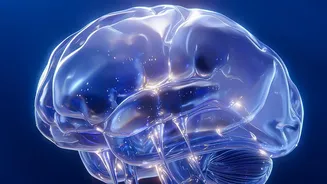








Our brain is not just a complex machine; it's a living museum. New research suggests its intricate wiring might be a map of our evolutionary history, with ancient structures and pathways still influencing how we think, feel, and act today.
An Echo of Ancient Life
Have you ever
wondered why the left side of your brain controls the right side of your body, and vice versa? It's one of the most peculiar facts of neuroanatomy, and for centuries, scientists have debated its purpose. A compelling new hypothesis suggests the answer isn't about a specific advantage, but about inheritance. Researchers propose that this cross-wiring is an evolutionary relic, a foundational blueprint laid down more than 500 million years ago that all subsequent brain developments were built upon. Essentially, our brain didn't start from scratch; it renovated, adding new layers and functions on top of a very old and established structure. This perspective reframes the brain as a historical document, where the connections between different regions tell a story of our deep ancestral past, from ancient fish to modern humans.
It All Started with Sight
The new hypothesis, published by researchers Martin Wessendorf and Daniel Wang, points to the visual system as the origin of this crossed circuitry. In all vertebrates, from fish to humans, the way our eyes process information is fundamentally 'crossed'. Because the lens of an eye reverses an image, what you see on your right is projected onto the left side of your retina. This information is then sent to the opposite hemisphere of the brain for processing. This happens in an ancient brain structure called the optic tectum (known as the superior colliculus in mammals), which is responsible for coordinating rapid responses to visual stimuli. The researchers argue that because this contralateral, or crossed, visual system was so fundamental and established so early in vertebrate evolution, it became the default template. As other sensory and motor systems evolved, they simply adopted the same crossed wiring plan.
Building New on an Old Foundation
Evolution is often described as a tinkerer, not an engineer starting from a blank slate. It modifies what already exists. The researchers suggest this is exactly what happened in our brains. As four-limbed animals (tetrapods) evolved, pathways for touch, pain, and movement developed. Instead of creating an entirely new, uncrossed system, evolution piggybacked on the existing visual wiring. Later, even uniquely mammalian structures like the cerebral cortex, which supports higher-order functions like language and abstract thought, inherited this arrangement. This includes the corticospinal tract, a pathway crucial for fine motor control, like the precise movements of our fingers. It may have developed by modifying older sensory pathways, inheriting their crossed nature in the process. This suggests that the way you type on a keyboard is, in a way, influenced by the brain structure of an ancient fish.
The Human Connectome: A Unique Map
While we share this basic blueprint with other animals, the human 'connectome'—the complete map of our brain's connections—has unique features. Comparative studies with chimpanzees, our closest living relatives, show that while the overall structure is similar, human brains have shifted towards greater integration and efficiency. Research suggests that as the human brain grew larger, it economized on long-range connections between the two hemispheres, favouring more connections within each hemisphere. This may have allowed for greater functional specialization, such as developing language-specific areas in one hemisphere. These human-specific adaptations in wiring likely supported the emergence of our complex cognitive abilities.
An Evolutionary Trade-Off?
This unique evolutionary path may have come at a cost. Some scientists theorize that the same modifications in brain connectivity that enabled higherorder functions might have also introduced new vulnerabilities. Studies have found a significant overlap between humanspecific brain circuits and the patterns of dysconnectivity seen in conditions like schizophrenia. This suggests that as our brains evolved for complex cognition, we may have become susceptible to certain neurological and psychiatric disorders. Understanding this evolutionary legacy is not just an academic exercise; it provides a crucial new framework for investigating mental health and brain disorders, viewing them not just as diseases, but as potential byproducts of our unique evolutionary journey.