




A Lonely Voyage Past Pluto
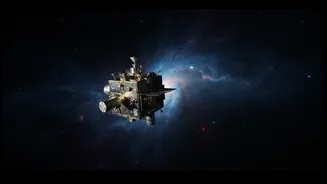
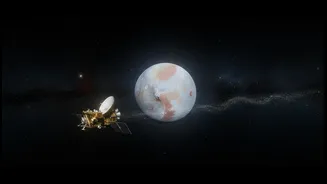
Launched in 2006, New Horizons is one of humanity's most ambitious explorers. Its primary claim to fame was the stunning flyby of Pluto in 2015, which completely rewrote our understanding of the dwarf planet. But the mission didn't end there. After sending
back breathtaking images of Pluto's heart-shaped plains and icy mountains, the probe journeyed onward, deeper into the Kuiper Belt, a vast ring of icy bodies beyond Neptune. In 2019, it made history again by visiting Arrokoth, the most distant object ever explored by a spacecraft. Now, it cruises through this cold, dark frontier, acting as our eyes and ears in a region humans have only just begun to chart.
The Need for a Long Nap
Traveling through deep space for decades requires careful management of resources. To preserve power from its nuclear battery and extend its operational life, mission controllers at the Johns Hopkins Applied Physics Laboratory periodically place New Horizons into a state of hibernation. The recent 321-day sleep, which began on August 7, 2025, was the longest in the mission's history. During this time, most of its systems are powered down, and it enters a stable spin, requiring minimal oversight from Earth. This strategy not only saves the spacecraft's precious energy but also reduces the cost and workload for the mission team on the ground. Weekly status beacons confirmed that all was well as it silently sailed through the void.
The Instruments That Never Rested
While the main spacecraft was largely asleep, three key scientific instruments were left running, continuously collecting data. These were the Solar Wind Around Pluto (SWAP) instrument, the Pluto Energetic Particle Spectrometer Science Investigation (PEPSSI), and the Venetia Burney Student Dust Counter (SDC). Together, these instruments function as a deep-space weather station. SWAP and PEPSSI are designed to measure the charged particles, or plasma, that make up the solar wind—the constant stream of particles flowing from our Sun. The SDC, as its name implies, does the crucial job of counting every tiny dust particle that impacts the spacecraft.
What Plasma and Dust Can Tell Us
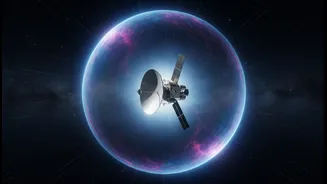
Why measure this seemingly empty space? Because it’s not empty at all. The data from these instruments is vital for understanding the heliosphere, the vast magnetic bubble the Sun creates around our solar system. By measuring how the solar wind’s density and energy change at such extreme distances, scientists can better understand the boundary where our Sun’s influence ends and interstellar space begins. This is a region only two other spacecraft, the Voyagers, have crossed. The dust measurements are equally important, providing clues about the composition and distribution of the Kuiper Belt's ancient building blocks, remnants from the formation of our solar system over 4.5 billion years ago.
Waking Up and Phoning Home
On June 23, 2026, acting on commands sent nearly a year prior, New Horizons successfully woke itself up. Flight controllers confirmed the good news after the signal traveled for 8 hours and 52 minutes to cross the 9.5 billion kilometres back to Earth. The first task for the mission team is to download the spacecraft's health data, followed by the trove of scientific information collected by SWAP, PEPSSI, and SDC during the long hibernation. This data, the first of its kind from this remote region, will occupy scientists for months and years, offering an unprecedented look at the environment at the solar system's edge.