









The Automated Dream
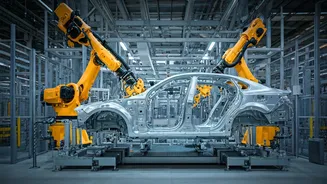
Like many global manufacturers, Ford invested heavily in artificial intelligence, hoping to streamline production, cut costs, and boost quality. The company deployed over 900 AI-powered cameras across its factories, creating a vast network designed to spot
defects that the human eye might miss. The goal was to automate quality control, feeding design requirements into smart systems and letting algorithms ensure every vehicle that rolled off the line was perfect. The promise was immense: tireless, hyper-vigilant inspectors working 24/7 to catch issues at the source, long before they could become costly recalls or warranty claims. CEO Jim Farley himself had spoken of AI’s transformative potential, making the company’s push a high-profile bet on the future of automation.
A Glitch in the System
Despite the advanced technology, the desired results didn't materialize. Ford executives admitted that an over-reliance on these automated systems was falling short. The problem wasn't that the AI was broken, but that it was incomplete. The systems were excellent at comparing a finished part to a perfect digital blueprint and flagging deviations. However, they lacked the nuanced, intuitive judgment of a seasoned professional. This is what experts call tacit knowledge—the 'gut feel' an engineer develops over decades of working with physical materials, hearing how a machine should sound, or knowing the difference between a minor cosmetic blemish and a critical structural flaw. Ford had made a crucial error: many of its most experienced engineers had left the company before their invaluable, real-world knowledge could be used to train the very AI systems meant to replace them.
Calling in the 'Gray Beards'
Faced with this reality, Ford made a strategic pivot. Over the past three years, the company quietly rehired more than 350 veteran engineers and technical specialists, many of whom were former employees. Internally known as the 'gray beards,' this experienced cohort was brought back to fill the knowledge gap. Charles Poon, Ford's vice president of vehicle hardware engineering, stated that the company had mistakenly thought simply introducing AI would produce a high-quality product. He acknowledged a key lesson: “Artificial intelligence is a fantastic tool, but it's only as good as the information you use to train it.” The returning specialists were tasked not just with inspecting vehicles, but with hunting for failure points before a part even reaches the factory floor.
A New Human-in-the-Loop Model
Ford's new approach isn't a retreat from AI but a recalibration of its role. The company is now building a 'human-in-the-loop' system where technology and human expertise work in tandem. In this hybrid model, the AI cameras do what they do best: perform high-speed, high-volume scanning to flag potential anomalies that might be invisible to a person. But instead of making the final call, the system triages the issues, filtering out the vast majority of acceptable parts and escalating only the questionable ones to the veteran engineers. These human experts then use their deep experience to make the final judgment, confirming or overriding the AI's findings. Crucially, the 'gray beards' are also responsible for mentoring younger employees and, most importantly, using their expertise to retrain and refine Ford's AI models, making them smarter and more effective over time.
Lessons for the Industry
The strategy appears to be paying off. Ford recently topped J.D. Power's Initial Quality Study among mainstream brands for the first time in 16 years, an achievement the company credits in part to this 'significant talent refresh'. While Ford still faces challenges with recalls, which its COO described as a lagging indicator, the company expects these numbers to decline as vehicles produced under the new quality process hit the market. Ford's experience serves as a powerful case study for businesses everywhere, particularly in a country like India that is rapidly embracing digital transformation. It highlights that the race to automate should not come at the expense of institutional knowledge. The most successful AI implementations may not be those that replace humans, but those that augment their irreplaceable expertise.