

The Universe's Missing Matter
For decades, scientists have grappled with a massive cosmic puzzle known as dark matter. It’s the invisible 'stuff' that makes up about 85 percent of all matter in the universe. We can't see it or touch it, but we know it's there because of the gravitational
pull it exerts, holding entire galaxies together and preventing them from spinning apart. Despite its abundance, the true nature of dark matter remains one of the most profound mysteries in science. Over the years, physicists have proposed various candidates, from undiscovered particles to new laws of physics. One of the most intriguing, yet elusive, possibilities involves a special type of black hole born not from dying stars, but from the fiery chaos of the Big Bang itself.
Meet the Primordial Black Holes
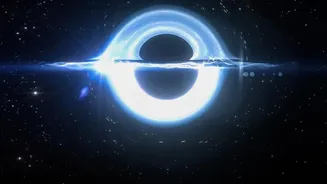
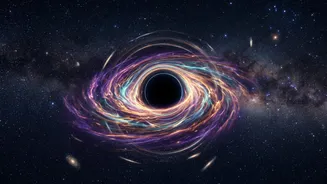
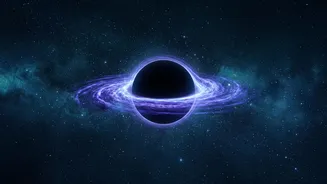
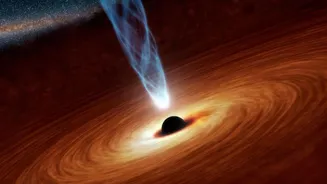
These aren't your typical black holes. Most black holes form when a massive star collapses under its own gravity. Primordial black holes (PBHs), on the other hand, are purely theoretical objects thought to have formed within the first fraction of a second of the universe's existence. In that incredibly dense, hot environment, pockets of matter could have become so compressed that they collapsed directly into black holes. If they exist, they could come in a vast range of sizes, from as small as an atom to many times the mass of our sun. This versatility makes them a compelling candidate for dark matter; they are massive, don't emit light, and would have been scattered across the early universe, perfectly fitting the description.
The Hunt for Ghostly Evidence
Proving the existence of PBHs is extraordinarily difficult. Because they don't shine, astronomers have to look for their subtle effects on their surroundings. Some search for moments when a PBH passes in front of a distant star, causing its light to momentarily brighten through an effect called gravitational microlensing. Others look for the faint glow of Hawking radiation, a theoretical emission that would cause the smallest PBHs to evaporate over eons. The headline-making update comes from a different style of research. A new study, set to be published in the journal Physical Review Letters, took a novel approach by analyzing the cosmic microwave background (CMB) — the faint, leftover light from the Big Bang.
Why No News Is Good News
The latest research focused on ruling out 'stupendously large' black holes — those heavier than entire galaxies — as a major component of dark matter. The team reasoned that if such massive objects made up a significant portion of dark matter, they would have left a specific, 'grainy' imprint on the temperature variations of the cosmic microwave background. After analyzing the data, they found no such pattern. This allowed them to conclude that these gigantic black holes cannot be the primary source of dark matter. However, and this is the crucial part, their study did not rule out the existence of smaller, asteroid-mass primordial black holes. By eliminating one possibility, the research inadvertently strengthens the case for continuing the search for these smaller, more nimble cosmic relics. The door remains wide open for them to be the dark matter candidates we've been looking for all along.
What This Means for Science
In science, progress is often made by chipping away at what is impossible until all that remains, however improbable, is the truth. This study is a perfect example of that process. While it definitively shrinks the pool of possibilities for dark matter, it also focuses the scientific community's attention more sharply on the remaining suspects. Researchers involved in the study noted that they are now turning their attention to investigating whether they can also rule out these smaller, asteroid-sized black holes. Other recent studies have also kept the PBH theory alive, with some scientists suggesting that a PBH passing through a white dwarf star could trigger a specific type of supernova explosion, leaving behind chemical clues for us to find. Each study, whether it finds something or finds a lack of something, adds a valuable piece to the puzzle.