




First, What Is 'Warm Rain'?
Most of the rain that falls during the Indian monsoon is what scientists call 'warm rain'. This might sound obvious, but it refers to a specific process. Unlike 'cold rain', which starts as ice crystals high up in the sub-zero atmosphere, warm rain forms
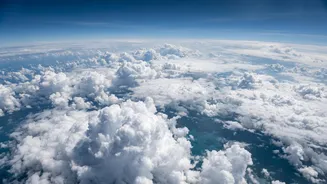
entirely in clouds with temperatures above freezing. This process, known as collision and coalescence, is dominant in the tropics. It begins when water vapour condenses onto microscopic particles like dust or salt, forming tiny cloud droplets. These droplets are too light to fall, so they drift within the cloud, bumping into and merging with each other. Over time, they grow larger and heavier until they can overcome the upward air currents and fall to the ground as rain. Understanding this fundamental process is the first step to decoding the monsoon's intricate behaviour.
The Complicating Factor: Pollution
For years, a major question for climate scientists has been how India's rising air pollution affects the monsoon. The countless tiny particles, or aerosols, released from traffic, industry, and burning biomass were thought to have a significant impact. The prevailing theory was often one of suppression: a sky full of pollutants could lead to a larger number of smaller cloud droplets. These smaller droplets are very light and struggle to combine and grow heavy enough to fall, potentially delaying or weakening rainfall. This idea suggested that in some cases, pollution could be making clouds less efficient at producing rain. However, the exact mechanisms have been difficult to prove, as what happens inside a turbulent monsoon cloud is incredibly complex.
A Surprising Discovery from Inside the Clouds
To get clearer answers, scientists from the Indian Institute of Tropical Meteorology (IITM) in Pune have been conducting daring experiments, flying specially equipped aircraft directly into active monsoon clouds. A landmark study from June 2026 delivered a surprising result. Researchers measured the composition of individual cloud droplets and found that very few—less than 3%—contained particles of black carbon, or soot. This was unexpected, as black carbon is a widespread pollutant. While it is still a major factor in warming the atmosphere, this finding suggests it may not be acting as the primary seed for cloud droplets in the way many models assumed. This indicates the relationship between pollution and rainfall is far more nuanced than a simple cause-and-effect.
The Mystery of the Vanishing Rain
Another recent insight from IITM researchers, published in July 2026, revealed another critical piece of the puzzle: a significant amount of monsoon rain never actually reaches the ground. Their measurements showed that, on average, about a quarter of all rainfall over the Western Ghats evaporates in the dry air beneath the cloud base. This process, called sub-cloud evaporation, has a profound impact. As the water evaporates, it cools the surrounding air, creating downdrafts and pockets of cold air near the surface. This can alter air circulation and influence where the next storm cell forms. This phenomenon, which had never been quantified in India before, helps explain why weather models often struggle to predict the exact location and intensity of monsoon showers.
What This Means for Monsoon Forecasting
These new findings don't mean pollution is good for the monsoon. Instead, they provide a much-needed dose of reality for climate models. By revealing the complex role of aerosols and quantifying processes like mid-air evaporation, this research helps scientists refine the physics inside their prediction models. The old assumption might have been that more pollution simply equals less rain, but the reality is a delicate balance of factors, including the type of aerosol, atmospheric humidity, and cloud dynamics. Getting these small-scale, or 'microphysical', details right is essential for improving the accuracy of both short-term weather forecasts and long-term climate projections, which are vital for an economy so deeply tied to the monsoon's rhythm.