









The Holy Grail of Rocketry
For decades, rockets were feats of single-use engineering. Billions of rupees worth of advanced hardware would power a satellite into orbit for a few minutes, only to be discarded and fall into the ocean as scrap. Then came reusability, a concept pioneered
and perfected by companies like SpaceX, which completely rewrote the economics of spaceflight. By recovering and reflying the most expensive part of the rocket—the first-stage booster—launch costs plummet and the frequency of missions can skyrocket. This is now widely seen as the defining feature of a modern launch provider. Chennai-based Agnikul Cosmos, a startup incubated at IIT Madras, is now embarking on this journey, aiming to become the first Indian private entity to recover an orbital-class booster. Success would not just be a technical victory; it would be a commercial game-changer for India's burgeoning space ecosystem.
What is a Controlled Descent?
Imagine throwing a skyscraper-sized pen into the air so high that it almost reaches space, and then having it fall back down and land perfectly upright on a tiny floating platform in the middle of the sea. That, in essence, is the challenge of booster recovery. A controlled descent is the process of managing a rocket stage's fall back through the atmosphere. After separating from its payload-carrying upper stage, the booster is travelling at hypersonic speeds. It must first survive the intense heat of atmospheric reentry, then orient itself, slow down dramatically, and steer itself towards a precise landing zone. This requires a symphony of advanced systems working in perfect harmony: heat shields to protect against plasma, grid fins (waffle-like fins) and thrusters to steer the vehicle, and finally, a series of engine burns—called retro-propulsive burns—to slam on the brakes just before touchdown.
Agnikul’s Ambitious Game Plan
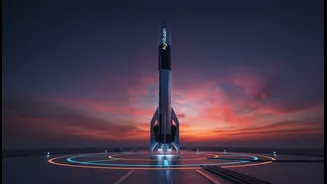
Agnikul's upcoming 'Mission-02' will be its first attempt at this feat. The mission will fly a two-stage Agnibaan rocket. After the first stage separates, it will attempt a controlled descent and splashdown in the ocean. While an ocean recovery is simpler than a pinpoint landing, it's a critical first step to prove the guidance, navigation, and control systems. Future versions will be more ambitious, targeting a vertical landing on a sea-based barge, much like a SpaceX Falcon 9. To achieve this, the Agnibaan booster will be equipped with landing legs, grid fins, and its own independent flight computer. This attempt is built on the confidence gained from Agnikul's successful 'SOrTeD' suborbital test flight in May 2024, which validated the core performance of its unique, single-piece 3D-printed semi-cryogenic engine. The company believes it already has much of the necessary guidance experience and doesn't want to waste the opportunity to test it.
India’s Two-Pronged Push for Reusability
Agnikul's effort places it at the forefront of a major technological race within India. While the Indian Space Research Organisation (ISRO) has its own impressive reusability program—the Reusable Launch Vehicle (RLV), which resembles a small spaceplane and lands horizontally on a runway—Agnikul is pursuing the vertical-landing model. These two different philosophies represent a healthy and diverse national strategy. ISRO's approach is methodical and government-led, aiming for a larger-class vehicle in the long term. Agnikul, along with other startups, represents the nimble, fast-moving private sector, eager to prove the technology on a smaller scale and potentially get to market faster. The fact that former ISRO Chairman S. Somanath has joined Agnikul's board as an observer underscores the national significance of this private-sector push.
Beyond the Booster
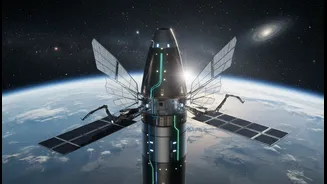
Agnikul's ambitions for Mission-02 don't end with recovering the booster. In a clever twist, the company also plans to test an extended life for the rocket's upper stage. Typically, the upper stage, which carries the satellite into its final orbit, becomes space debris after deployment. Agnikul, however, has patented a 'convertible upper-stage architecture'. This design would allow the spent upper stage to transform into a functional, in-orbit platform that could host experiments or test other technologies, essentially turning junk into a valuable asset. This dual focus on recovering the first stage and repurposing the second stage shows a deep commitment to a philosophy of not throwing anything away, maximising value from every part of the rocket and every kilogram launched into orbit.