






Follow the Seasons of the Sky
Just as the Earth’s landscape changes with the seasons, so does the night sky. As our planet orbits the sun, the dark side of Earth faces different directions in space, revealing a rotating cast of constellations. This seasonal shift is the first step
in planning your trip. For Northern Hemisphere observers, each season offers its own unique highlights. Knowing what’s visible and when will help you decide the best time to travel for the sights you want to see most.
Winter: The Clearest Views
Winter is often called the 'observing season' by astronomers. The cold, crisp air typically holds less haze, leading to exceptionally clear skies and longer nights. This is the prime time to see some of the most famous constellations. The mighty hunter, Orion, dominates the winter sky with his unmistakable three-star belt. Following him are his two dogs, represented by Canis Major and Canis Minor, which contain the brightest star in the night sky, Sirius. Also prominent is Taurus the Bull. For those tracking meteor showers, the powerful Geminids peak in mid-December, and the Quadrantids arrive in early January.
Spring and Autumn: Transitional Skies
Spring and autumn offer a gateway to different parts of our galaxy. In spring, the sky is less cluttered by the bright plane of the Milky Way, providing a clearer view into deep space, making it a favorite for astronomers looking for other galaxies. Key constellations include Leo the Lion, Virgo the Maiden, and the easily recognisable Ursa Major, which climbs to its highest point in the sky. Autumn brings constellations like Cassiopeia, with its distinct 'W' shape, and Pegasus into view. Meteor showers to watch for include the Lyrids in April, the Orionids in October, and the Leonids in November.
Summer: The Milky Way's Grand Display
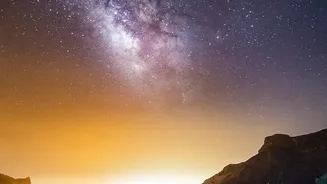
Summer is the season for the Milky Way. From June to August in the Northern Hemisphere, the bright, dense core of our galaxy is perfectly positioned for viewing. Look for the Summer Triangle, an asterism formed by three bright stars—Vega, Deneb, and Altair—from the constellations Lyra, Cygnus, and Aquila. This celestial landmark is a great starting point for navigating the summer sky. The famous Perseid meteor shower, one of the most popular of the year, peaks in mid-August, often producing over 50 meteors per hour.
Decoding Sky Conditions
Beyond the season, two main factors will determine the quality of your stargazing: light pollution and the Moon. Artificial light from cities creates 'skyglow' that washes out all but the brightest stars. To find truly dark skies, you need to get away from urban centres. The second factor is the Moon. A full moon can be as disruptive as city lights, its brightness obscuring fainter objects. For the best experience, plan your trip during the new moon phase, when the sky is at its darkest. Finally, always check the local weather forecast for cloud cover before you head out.
Finding Your Dark Sky Haven
The ideal stargazing destination combines high altitude, low humidity, and minimal light pollution. Places officially certified by DarkSky International as 'Dark Sky Parks' or 'Reserves' are guaranteed to have protected night skies. In India, several locations offer world-class stargazing due to their unique geography. The high-altitude cold deserts of Ladakh and Spiti Valley in the Himalayas provide some of the clearest and darkest skies in Asia. Places like Hanle in Ladakh, home to the Indian Astronomical Observatory, and villages like Kaza and Kibber in Spiti are renowned for their views. Other excellent options include the vast, flat expanse of the Rann of Kutch in Gujarat, the remote Andaman Islands, and the hills of Coorg in Karnataka during the dry season.