


A Solar Masterpiece Revealed
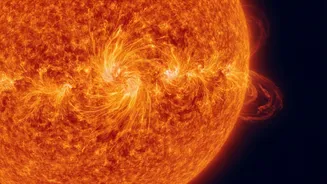
Scientists have released the highest-resolution images ever taken of the Sun's surface, offering an exceptionally detailed look at its atmosphere. These images were captured by the National Science Foundation's Daniel K. Inouye Solar Telescope, which
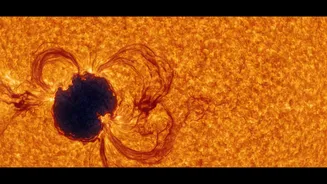
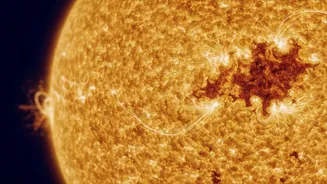
is located on the Haleakalā volcano in Maui, Hawaii. The images focus on the Sun's photosphere and chromosphere, the layers of its atmosphere just above the visible surface. They reveal a landscape of seething, cell-like structures called granules, each about 1,600 kilometres across. The level of detail is so immense that features as small as a city can be clearly distinguished. This unprecedented view allows scientists to observe the fine-scale structures of the Sun's magnetic fields and plasma, which appear as intricate swirls and hair-like jets of fiery gas.
The Eye on the Sun
The Daniel K. Inouye Solar Telescope represents a massive leap in our ability to study the Sun from Earth. As the largest solar observatory in the world, its primary mirror measures four meters (about 13 feet) in diameter, allowing it to collect more sunlight than any other solar telescope. This incredible light-gathering power is what enables it to produce such sharp images. Situated 10,000 feet above sea level, the telescope's location in Hawaii provides the clear skies and minimal atmospheric distortion needed for crisp observations of our star. After a quarter-century of planning, the telescope is now fully operational and poised to revolutionise solar physics by providing continuous, high-resolution data throughout the Sun's 11-year activity cycle.
Decoding the Sun’s Fiery Engine
The new images are more than just beautiful pictures; they provide the first direct evidence of a long-theorised process called the Kelvin-Helmholtz instability (KHI) on the Sun's surface. This instability occurs when two fluids or gases moving at different speeds interact, creating waves and swirling vortices. On the Sun, this happens at the boundaries of magnetic plasma streams. Scientists observed tiny whirlpools, some just 20 kilometers wide, continually forming and dissipating. These swirls are believed to play a crucial role in transferring energy from the Sun's surface into its much hotter outer atmosphere, the corona. This discovery could help solve the long-standing mystery of why the corona is hundreds of times hotter than the surface below.
Why a Better Sun Forecast Matters
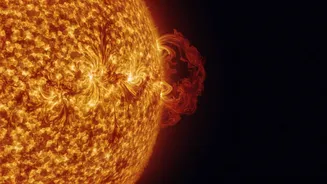
Understanding these intricate processes on the Sun has very practical implications for us on Earth. The same magnetic energy that creates these tiny swirls can build up and lead to massive solar events like solar flares and coronal mass ejections (CMEs). These powerful eruptions send streams of charged particles hurtling through space. If aimed at Earth, they can disrupt satellites, damage power grids, and interfere with communication and navigation systems. By studying how magnetic fields twist and release energy at a small scale, scientists can improve their models of space weather. The insights from the Inouye Solar Telescope will transform our ability to predict these events, giving us a better chance to prepare for and mitigate their impact on our technology-dependent society.