







A New Weather Satellite for Mars
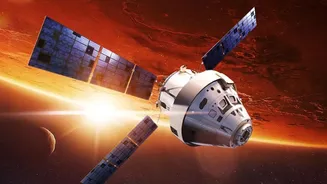
Since its arrival at Mars in February 2021, the United Arab Emirates' Hope probe has been doing something remarkable. Unlike many previous orbiters that have a tight, elliptical path, Hope maintains a high-altitude, near-equatorial orbit. This unique
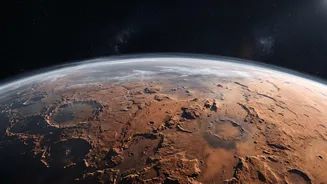
position allows it to function like a planetary weather satellite, capturing a complete picture of the Martian atmosphere every nine days. Previous missions could only grab snapshots of different regions at different times of day. Hope, for the first time since the Viking missions of the 1970s, provides a global, day-long view of Martian weather, observing how phenomena like dust storms grow and dissipate across the entire planet. This continuous monitoring is crucial for understanding the planet's atmospheric dynamics, a key piece of the puzzle in figuring out how Mars transformed from a potentially wet world to the cold desert it is today.
Mapping Extreme Temperature Swings
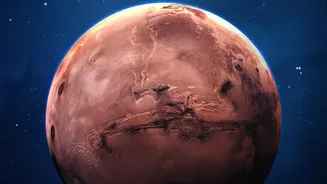
One of the most significant contributions of the Hope mission comes from its Emirates Mars Infrared Spectrometer (EMIRS). Recently, Indian scientists from the Physical Research Laboratory in Ahmedabad used EMIRS data to create the most detailed map yet of Mars' surface temperatures. Their study revealed extreme fluctuations, with temperatures ranging from a frigid -123°C to a relatively mild 22°C. These dramatic swings are a result of Mars' thin atmosphere, which is about 100 times less dense than Earth's and cannot effectively retain heat. Consequently, the surface heats up rapidly in sunlight and loses that heat just as quickly after sunset. Hope's ability to measure temperatures across the entire planet at all times of the day has provided a much clearer picture of these daily and seasonal thermal patterns, confirming its observations against on-ground measurements from NASA's rovers.
Decoding the Mysterious Zonal Waves
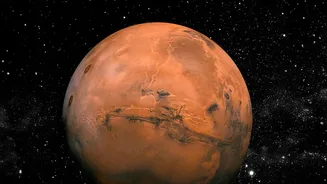
Beyond just temperature, the research by Indian scientists uncovered large-scale temperature patterns that move across the planet's surface like waves. Known as stationary planetary or 'zonal' waves, these are not waves in an ocean but large-scale ripples in atmospheric pressure and temperature. They are caused by the interaction of strong, jet-stream-like winds with Mars' varied topography, such as its vast basins and giant volcanoes. These waves offer an indirect glimpse into the planet's deep atmospheric circulation. The study found fascinating differences between Mars' great basins; the Argyre basin was dominated by a simple wave pattern, while the deeper Hellas basin showed more complex, multi-wave patterns that changed with the seasons. Understanding these waves is critical to building accurate climate models for Mars, which is a key step for planning future robotic and human missions.
A Boost for India's Mars Ambitions
While India's own Mars Orbiter Mission (Mangalyaan) was a landmark technological achievement, its scientific payload was modest compared to missions like Hope or NASA's MAVEN. Mangalyaan was primarily a technology demonstrator, proving India's capability for interplanetary travel on a shoestring budget. The data from Hope, therefore, doesn't compete with but powerfully complements India's own findings. It fills crucial gaps, particularly in atmospheric science. As ISRO plans future missions, including a potential Mars lander and the Gaganyaan human spaceflight program, this detailed understanding of Martian weather is invaluable. Accurate climate models are essential for selecting safe landing sites, designing habitats that can withstand extreme temperature shifts, and planning surface operations. The India-UAE space cooperation, formalized with MoUs and a joint working group, laid the groundwork for this type of scientific exchange, with India offering expertise from its Mangalyaan success.
Science Beyond Borders
The use of UAE's data by Indian scientists exemplifies a growing trend in space exploration: collaboration. National prestige remains a driver, but the sheer cost and complexity of interplanetary science make data sharing essential. Agencies like NASA regularly coordinate with ISRO, the UAE Space Agency, and ESA to ensure the safety of their respective orbiters and to share findings. For instance, a collaboration between the Hope probe and NASA's MAVEN orbiter led to the discovery of a new, patchy type of proton aurora on Mars. By combining the strengths of different instruments on different spacecraft, scientists can achieve insights that no single mission could alone. For India, this open data environment provides a powerful tool to accelerate its own scientific goals, leveraging global achievements to build more sophisticated and ambitious missions for the future.