






A Cosmic Detective Story
Imagine trying to piece together the details of a car crash that happened 10 billion years ago using only scattered debris. That’s the challenge facing galactic archaeologists. A new theory, presented at the 2026 National Astronomy Meeting, suggests our
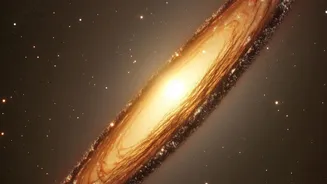
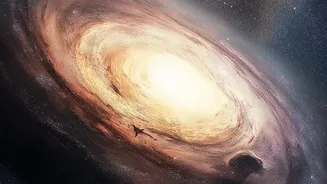
Milky Way was involved in a colossal head-on collision that was so powerful, it flipped the galaxy’s stellar disc. The main clue lies in the galaxy's stellar halo, a sparse, spherical cloud of ancient stars that surrounds the main disc. While stars in the disc, including our Sun, zip around at high speed, the halo barely seems to rotate at all. This strange lack of motion has puzzled scientists for years, but now they believe it’s the smoking gun from a dramatic, ancient upheaval.
The Prime Suspect: A 'Sausage' Galaxy
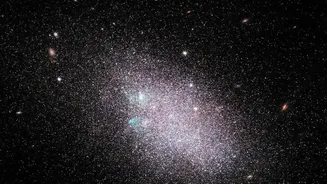
The culprit in this cosmic crime is thought to be a dwarf galaxy nicknamed Gaia-Sausage-Enceladus. The name comes from the sausage-like shape of the orbits of its former stars, discovered using data from the European Space Agency's (ESA) Gaia mission. About 10 billion years ago, long before our Sun was born, this smaller but still massive galaxy slammed into our own. It wasn’t a glancing blow, but a direct, head-on impact. The Milky Way, being much larger, ultimately won the gravitational battle, tearing the Sausage galaxy apart and absorbing its stars into what is now our stellar halo. This event is considered the last major merger in our galaxy's history and profoundly shaped its evolution.
How to Flip a Galaxy
So how exactly do you turn a galaxy on its side? It's not like flipping a pancake. The process is a slow, gravitational reorientation that can take hundreds of millions of years. Researchers from Durham University used powerful supercomputer simulations to model how galaxies like ours evolve. They found that galaxies with slow-rotating halos, like the Milky Way, almost always experienced a major head-on merger in their past that led to a "disc flip"—a change in orientation of more than 90 degrees. The collision with the Gaia-Sausage-Enceladus galaxy would have violently rearranged the orbits of stars and gas, gradually redirecting the entire system's angular momentum and causing the main disc to settle into a completely new orientation.
Gaia: The Ultimate Galaxy Mapper
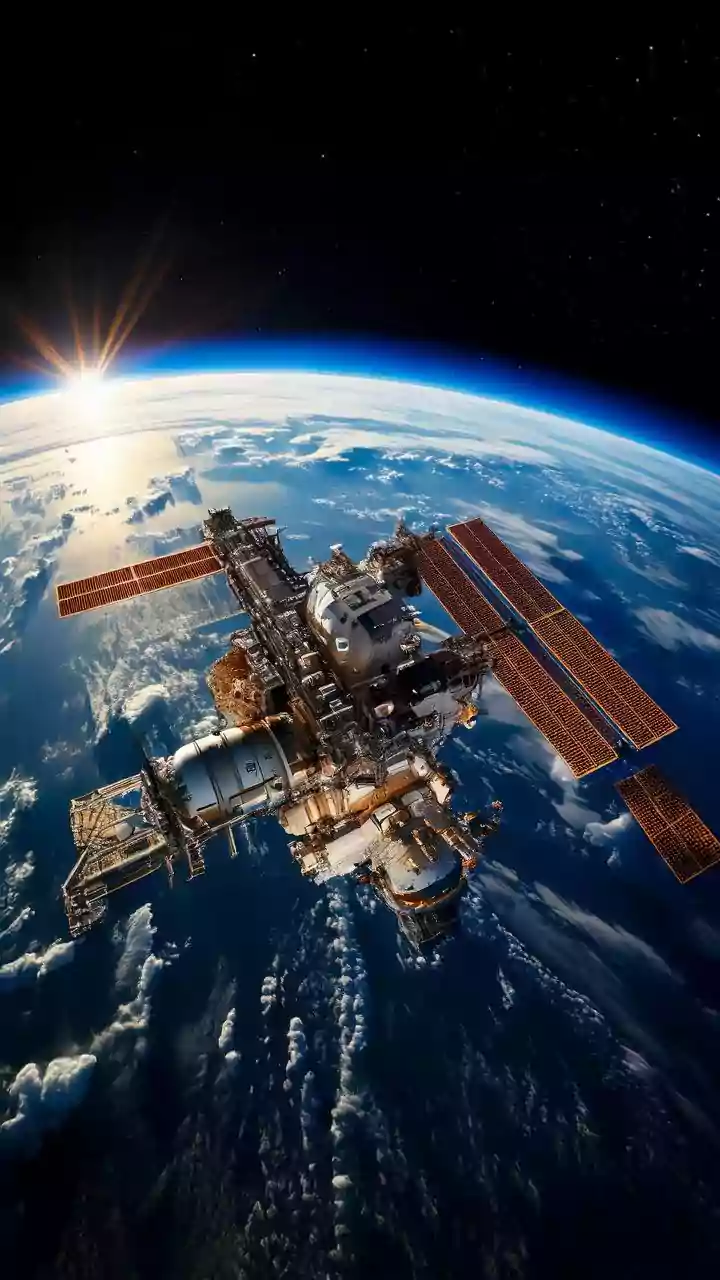
This incredible discovery would be impossible without the ESA's Gaia space observatory. Launched in 2013, Gaia has been on a mission to create the most precise three-dimensional map of the Milky Way ever attempted. By tracking the positions, movements, and distances of nearly two billion stars with mind-boggling accuracy, Gaia allows scientists to rewind time and reconstruct the galaxy's history. It can identify families of stars moving in strange ways, like the remnants of the Sausage galaxy, and provides the hard data needed to test complex simulations of cosmic evolution. Gaia’s data is effectively a time machine, revealing the ripples and scars left by ancient, galaxy-shaping events.