




Meet NASA’s New Cosmic Cartographer
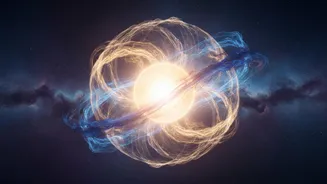
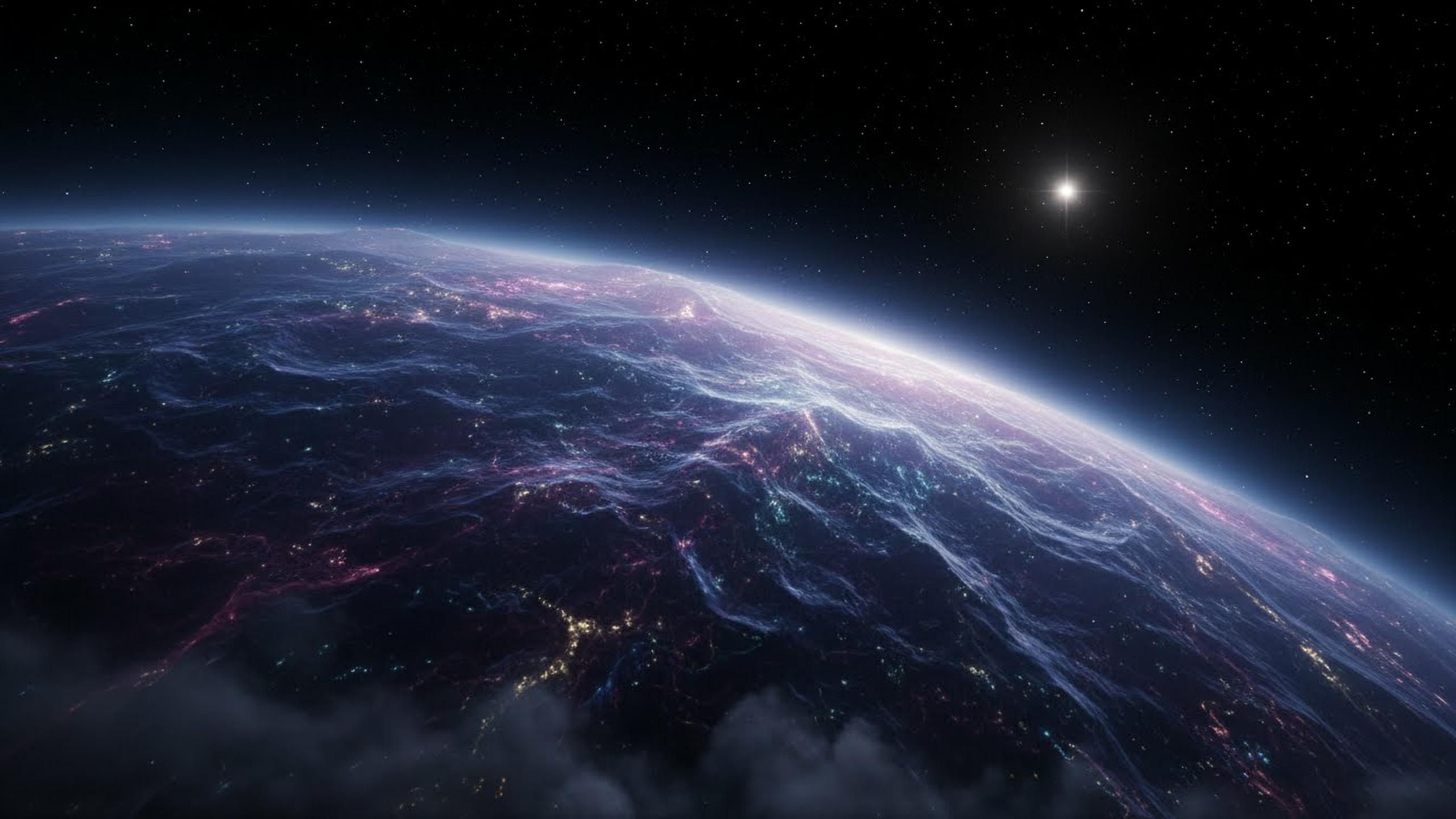
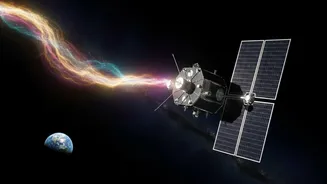
Launched in September 2025, the Interstellar Mapping and Acceleration Probe, or IMAP, is on a crucial mission. Its job is to explore the boundary of our solar system, a vast magnetic bubble called the heliosphere. This bubble, created by the constant
outflow of particles from the Sun known as the solar wind, acts as a protective shield, deflecting the harsher radiation from the wider galaxy. Positioned about 1.5 million kilometres from Earth towards the Sun, IMAP uses ten sophisticated instruments to sample particles and map this distant frontier. The mission has two primary goals: to understand how particles in the solar wind are energized and to study how this wind interacts with the interstellar medium—the material that fills the space between star systems.
The Sun's Constant, Powerful Breath
The solar wind is more than just a gentle breeze; it's a relentless stream of charged particles—mostly electrons and protons—ejected from the Sun's upper atmosphere at speeds of hundreds of kilometres per second. While the Earth's magnetic field protects us from a direct hit, this solar wind is responsible for 'space weather'. Intense bursts, known as solar storms, can endanger astronauts, disrupt satellite communications, damage power grids on Earth, and interfere with GPS signals. Understanding the solar wind's structure and behaviour is therefore not just an academic exercise; it is vital for protecting our increasingly technology-dependent civilisation and ensuring the safety of future space exploration missions.
What the First Data Reveals
In early August 2026, the IMAP team released the first public data sets from seven of its ten instruments. This initial release provides a treasure trove of information, offering the most detailed look yet at the composition and energy of solar wind particles and interstellar atoms. Instruments like SWAPI (Solar Wind and Pickup Ions) and CoDICE (Compact Dual Ion Composition Experiment) are measuring the particles directly, while others are mapping the heliosphere's structure by observing the light emitted when solar wind interacts with neutral atoms from interstellar space. A key part of this release is the real-time data stream called I-ALiRT, which is already being used by forecasters at NOAA's Space Weather Prediction Center to improve the timeliness of warnings for energetic particle events.
A Sharper Picture of Our Place in the Galaxy
This new data provides a much clearer view of the dynamic boundary that separates our solar system from the rest of the galaxy. By combining direct sampling of particles with remote imaging of the heliosphere's edge, IMAP bridges the gap between what's happening near Earth and the vast structures in the outer solar system. This helps scientists test and refine their models of how the heliosphere works. For the first time, they can directly link the properties of the solar wind measured at Earth's orbit with the global structure of our system's protective bubble. The mission builds on the legacy of probes like Voyager and the Interstellar Boundary Explorer (IBEX) but with far more advanced instruments, promising to solve long-standing mysteries about our cosmic shield.
Why This Cosmic Shield Matters
The heliosphere is fundamental to life on Earth. It helps shield us from a significant amount of high-energy cosmic rays that originate from supernova explosions and other violent events in the galaxy. Without this protective bubble, the level of dangerous radiation reaching Earth would be much higher. Understanding the physics of this boundary, how it filters particles, and how it changes over the Sun's 11-year activity cycle is key to understanding our habitable solar system. As humanity looks to venture farther into space with missions like Artemis, a detailed understanding of the radiation environment provided by IMAP is not just beneficial—it's essential for mission planning and astronaut safety.