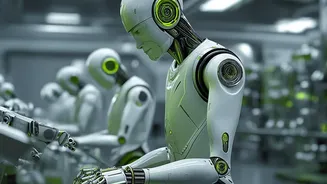




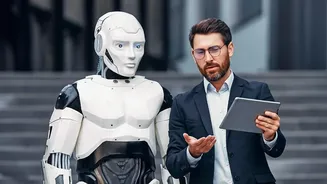

As artificial intelligence becomes a standard collaborator in the workplace, the conversation is shifting from job replacement to job transformation. The key question for 2030 is no longer if we will work with AI, but how.
The New Digital Coworker
By 2030, artificial intelligence
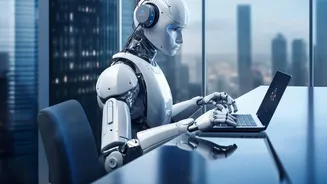
will be an integral part of nearly every business function. According to a Gartner survey, CIOs expect that 75% of IT work will be performed by humans augmented by AI, with the remaining 25% handled by AI alone. This rapid integration is forcing a fundamental rethink of what it means to be a valuable employee. The World Economic Forum (WEF) notes that 86% of businesses anticipate AI will significantly transform their operations by 2030. However, this transformation isn't about replacing humans entirely. Instead, it's about creating a 'Co-Pilot Economy' where AI handles routine, data-heavy tasks, freeing up human workers to focus on more complex and strategic work. The focus is shifting from performing automatable tasks to orchestrating outcomes with AI as a partner.
Beyond Technical Proficiency
While AI literacy will be a baseline requirement, the most in-demand skills of 2030 are not purely technical. Reports from the WEF and other analysts consistently show that as AI handles more of the 'what', the value of human employees will come from their ability to handle the 'why' and 'how'. The most sought-after skills are increasingly human-centric. Employers are recognising that the biggest barrier to AI adoption is not technology, but the skills gap within their workforce. The future of work requires a blend of digital literacy with distinctly human skills like creativity, adaptability, and critical thinking. Professionals who combine industry expertise with the ability to strategically apply AI will hold a significant advantage.
The 2030 'Human' Skills List
Forecasts consistently highlight a set of durable, human-centric skills as critical for the 2030 workplace. Analytical and creative thinking are at the top of the list. The ability to analyse complex information, generate novel ideas, and solve problems creatively are skills AI cannot easily replicate. Other crucial competencies include leadership and social influence, resilience, flexibility, and agility. Emotional intelligence, empathy, and strong communication skills are also seen as essential for collaboration and leadership in a hybrid human-AI environment. In essence, as machines take over repetitive cognitive tasks, the skills that make us most human—our ability to think critically, connect with others, and adapt—become our greatest professional assets.
The Irreplaceable Role of Judgment
Perhaps the most vital human skill in the age of AI is judgment. AI excels at processing data and identifying patterns, but it lacks the nuanced understanding, ethical reasoning, and contextual awareness that inform good decisions. Human judgment is critical for interpreting AI_generated insights, navigating ethical dilemmas, and making strategic choices, especially when data is incomplete or ambiguous. Researchers have noted that over_reliance on AI can erode critical thinking skills, making it harder for professionals to develop the very judgment needed to oversee these systems. In high_stakes areas like hiring, strategy, and crisis response, human oversight is non_negotiable. The most successful organisations will be those that use AI to augment human capabilities, not replace them, ensuring that a human is always in the loop for critical decisions.
Preparing for the Human_AI Partnership
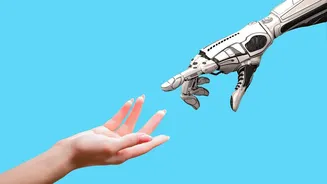
The transition to an AI_augmented workforce requires a proactive approach from both individuals and organisations. For employees, the emphasis must be on lifelong learning and adaptability. This means not just acquiring new technical skills like AI fluency, but deliberately cultivating human_centric abilities like critical thinking and creative problem_solving. For businesses, the focus should be on reskilling and upskilling their existing workforce. This involves redesigning roles to facilitate human_AI collaboration and creating learning pathways that help employees move from simple execution to higher_value strategic work. Ultimately, the future of work isn't a competition between humans and machines, but a partnership. Success will depend on our ability to leverage AI's power while doubling down on the human intelligence that gives it direction and purpose.