





What Exactly Is Floating Solar?
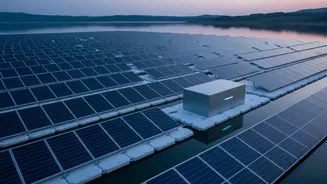
Floating solar, also known as 'floatovoltaics', involves mounting solar photovoltaic (PV) panels onto buoyant structures that float on the surface of water bodies. Instead of covering acres of fields or deserts, these power plants are installed on reservoirs,
lakes, and dam backwaters. The fundamental technology is the same as land-based solar farms: converting sunlight into electricity. The key difference lies in the innovative use of otherwise unused water surfaces, a particularly attractive proposition for densely populated countries.
The Land-Saving Advantage
India faces the dual challenge of rapid urbanisation and an increasing need for agricultural land, making large land parcels for traditional solar farms a significant constraint. Ground-mounted solar projects require vast areas, often leading to complex land acquisition processes that can bottleneck development. Floating solar elegantly sidesteps this issue by repurposing the surfaces of existing water bodies. This approach is crucial for diversifying solar installations geographically, especially in states with large reservoirs but limited available land.
More Than Just Saving Space
The benefits of floatovoltaics extend beyond land conservation. Placing solar panels over water has a natural cooling effect, which can increase their energy generation efficiency by 5–15% compared to their land-based counterparts that get hot under the sun. Furthermore, these floating arrays reduce water evaporation from reservoirs by providing shade and acting as a physical barrier. This is a critical advantage for water conservation in drought-prone regions. Some studies also suggest they can help improve water quality by limiting the growth of algae.
India's Major Push Explained
The "major push" for floating solar in India was solidified in late July 2026 with the Union Cabinet's approval of the Pradhan Mantri Surya Sarovar Yojana (PM-SSY). This ambitious scheme, with an outlay of ₹5,070 crore, aims to install 5,000 MW (5 GW) of floating solar capacity by 2030-31. The policy is designed to significantly scale up India's current floating solar capacity of about 700 MW. It provides Central Financial Assistance to developers and includes a mandatory provision for co-located battery energy storage systems to improve grid reliability. This initiative builds on the success of pioneering projects like the 100 MW plant at NTPC Ramagundam in Telangana and the 92 MW project in Kayamkulam, Kerala. The country is also home to what is planned to be one of the world's largest floating solar installations at the Omkareshwar dam in Madhya Pradesh.
Challenges on the Horizon
Despite its clear advantages, the path for floating solar is not without obstacles. The initial capital cost for these projects is higher than for ground-mounted systems due to the need for specialised floats, mooring systems, and waterproof cabling. There are also technical complexities related to designing installations that can withstand strong winds, waves, and fluctuating water levels. While the technology is promising, long-term research on its potential impact on aquatic ecosystems is still developing, and maintenance can be more challenging on water than on land.