


A New Window on Our Star
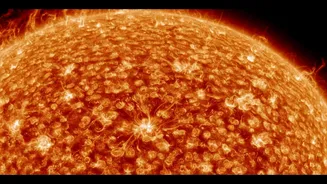
The image, captured by the National Science Foundation's Daniel K. Inouye Solar Telescope in Hawaii, provides an unprecedented close-up of the sun's visible surface, known as the photosphere. While NASA collaborates and promotes these findings, the telescope
itself is a ground-based marvel of engineering. The images are so sharp they can resolve features as small as a city on a surface area roughly the size of Earth. This allows scientists to move beyond theoretical models and directly observe the physical processes shaping our star in real-time. The image, which appears as a golden, textured surface, is actually a false-color representation of light captured in the deep blue spectrum. What it reveals are the tops of churning solar granules—convection cells of plasma that bring heat from the sun's interior to its surface.
Decoding the Plasma Dance
The sun isn't a solid ball but a super-heated sphere of ionized gas called plasma. This plasma is constantly in motion, driven by immense magnetic forces. The new image has, for the first time, provided direct visual evidence of a phenomenon known as the Kelvin-Helmholtz instability (KHI). This instability occurs when two streams of plasma flow past each other at different speeds, creating waves and swirls much like wind over water. For decades, KHI was only predicted by theory to exist on the sun, but these new observations confirm its presence in the form of streaks and swirls at the edges of the flower-like solar granules. Seeing this process is crucial because it's a key mechanism for how energy and magnetism move across the sun.
Solving Solar Mysteries
This detailed view of energy transfer is more than just a scientific curiosity; it could be the key to solving some of the sun's most enduring mysteries. For instance, scientists have long puzzled over why the sun's outer atmosphere, the corona, is millions of degrees hotter than its surface. The Kelvin-Helmholtz instability may play a role in transporting the energy required for this extreme heating. Furthermore, the sun's magnetic poles flip every 11 years, a rapid cycle that requires its magnetic fields to dissipate and reorganize with incredible efficiency. Understanding how KHI helps mix and move magnetic energy could provide a missing piece of that puzzle. These observations will allow researchers to refine their models of solar behavior, leading to a more complete picture of the engine that drives our solar system.
Why This Matters on Earth
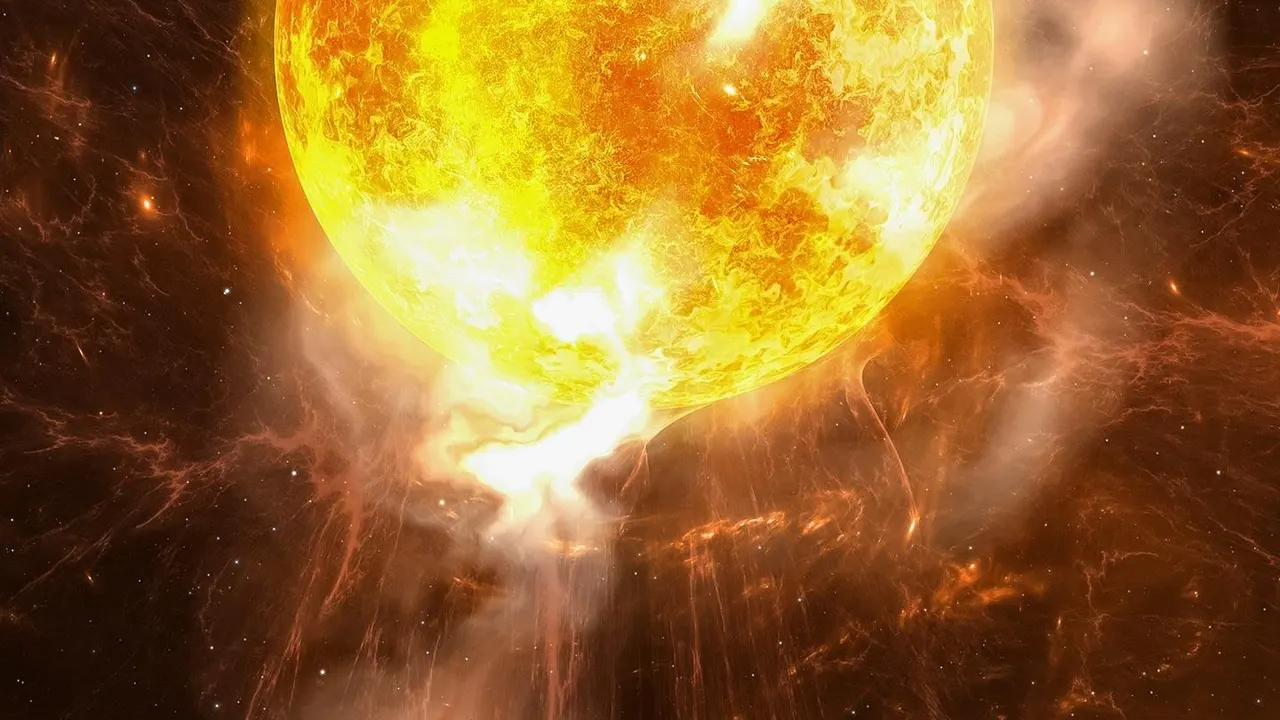
Understanding the sun's behavior is vital for life on Earth. While our planet's atmosphere and magnetic field protect us from the worst of the sun's outbursts, our technology is highly vulnerable. Violent solar events, like solar flares and coronal mass ejections (CMEs), launch massive clouds of plasma and radiation into space. When aimed at Earth, these events can trigger geomagnetic storms that have the power to disrupt GPS signals, damage satellite electronics, and even take down entire power grids. The 1989 Hydro-Quebec blackout in Canada serves as a stark reminder of this threat. By providing a clearer view of the fundamental physics driving solar activity, these new images will help improve our ability to forecast space weather, giving us a better chance to protect the critical infrastructure we all depend on.