







The High Cost of Sitting Still
Spending the majority of your day in a chair can take a significant toll on your body. Prolonged sitting is linked to a host of issues, including chronic back pain, tight hips, and neck strain. When we sit for hours, our core muscles can disengage, our hip flexors
shorten, and our posture often deteriorates into a slouch, putting pressure on the spine. This inactivity can also affect circulation and even dampen our energy and focus. Experts agree that breaking up long periods of sitting is crucial for long-term health, and even short, simple movement breaks can make a world of difference.
Seated Cat-Cow for Spinal Flexibility
This classic yoga movement is easily adapted for your office chair and is fantastic for relieving tension in your back and neck. Sit at the edge of your chair with both feet flat on the floor and your hands on your knees. On an inhale, arch your spine, roll your shoulders back, and look up toward the ceiling, creating a gentle backbend (Cow Pose). On your exhale, round your spine, drop your chin to your chest, and let your shoulders curve forward (Cat Pose). Flow between these two positions for 8-10 breaths to awaken your spine and release built-up stiffness.
Chair Pigeon Pose for Hip Relief
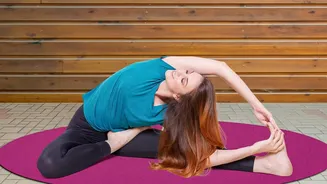
Tight hips are a common complaint among desk workers. The Chair Pigeon Pose is a safe and effective way to stretch the deep gluteal muscles and open the hips without ever leaving your seat. While sitting tall, cross your left ankle over your right knee, keeping the left foot flexed to protect the knee joint. You should feel a gentle stretch in your left hip. For a deeper sensation, you can slowly and carefully lean your torso forward. Hold the position for five deep breaths, then gently release and switch to the other side.
Seated Spinal Twist to Mobilise Your Torso
Twisting poses are excellent for improving spinal mobility and digestion, and they can feel incredibly refreshing after hours of facing forward. Sit tall in your chair, with your feet flat on the floor. On an exhale, gently twist your torso to the right, using your hands on the armrest or the back of the chair to deepen the stretch. Keep your hips facing forward as much as possible. With each inhale, try to lengthen your spine, and with each exhale, see if you can twist a little further. Hold for five breaths before returning to the centre and repeating on the left side.
Desk Upward Dog for a Chest Opener
To counteract the forward hunch that often develops over a computer, a gentle backbend is essential. Stand a few feet from your desk and place your palms on the edge, shoulder-width apart. Walk your feet back until your body forms a straight line. Gently lower your hips toward the desk, lift your chest, and look forward or slightly up. This will create a stretch across your chest and the front of your shoulders. It's a great way to reverse the curve of your spine from sitting. Hold for a few breaths, ensuring there's no pinching in your lower back.
Making Movement a Daily Habit
The key to success is consistency. Integrating these movements into your workday doesn't have to be complicated. Try setting a reminder on your phone or calendar to get up and stretch every hour. Another strategy is to 'habit stack'—for example, every time you finish a long email or a phone call, perform one of the stretches. You can even just take a moment for shoulder rolls or an assisted neck stretch. The goal isn't to complete a full yoga class, but to introduce regular, mindful movement that breaks the cycle of stillness.