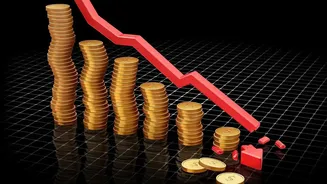








The Panic Button Instinct
When you see your portfolio value drop, your brain can perceive it as a genuine threat. This triggers a 'fight or flight' response, where the impulse to sell everything feels like a survival instinct. This phenomenon is rooted in loss aversion, a psychological
bias where the pain of losing money is roughly twice as powerful as the pleasure of gaining an equivalent amount. During sharp market downturns, this emotional reaction can be overwhelming, pushing investors to liquidate assets at what is often the worst possible moment. This emotional decision-making, amplified by sensational news headlines and the herd mentality of seeing others sell, is what defines panic selling. It's a reaction based on fear, not a rational analysis of your long-term financial plan.
The Hidden Cost of Market Timing
The greatest danger of panic selling isn't just locking in temporary losses; it's missing the recovery that often follows. Research consistently shows that the market's best days frequently occur in close proximity to its worst days. An analysis by FundsIndia, for example, found that an investment of ₹10 lakh in the Nifty 50 TRI from 1999 to 2026 would have grown to ₹2.84 crore. However, if an investor missed just the 15 best trading days in that 27-year period, their final corpus would have been only ₹95 lakh. This staggering difference highlights a crucial truth: a significant portion of long-term returns is generated during very short, powerful rebounds. By selling in a panic, you not only realize a loss but also position yourself on the sidelines, likely missing the very days that are essential for wealth creation. Trying to time the market requires you to be right twice: once when you sell and again when you buy back in. This is a feat that even seasoned professionals struggle to achieve consistently.
The Power of the Annual Check-In
If daily portfolio checking fuels anxiety, the annual review fosters discipline. Instead of reacting to a constantly fluctuating number, a once-a-year review forces you to step back and look at the bigger picture. This less frequent, more deliberate approach helps filter out the short-term market 'noise' and re-centers the focus on your long-term strategy. How often you check your portfolio directly impacts how volatile it seems. Daily price movements are erratic, but annual returns are significantly smoother. By scheduling a review just once or twice a year, you align your behavior with your investment horizon. This transforms your portfolio from a source of daily stress into a tool that is quietly working towards your future goals. The purpose of this check-in isn't to time the market, but to ensure your investments are still aligned with your life.
What to Review: Your Goals, Not the Noise
A productive annual review has little to do with the market’s recent performance. Instead, it’s about your own life and goals. Ask yourself: Has my financial situation changed significantly? Has my timeline for a major goal, like retirement or a home purchase, shifted? Is my risk tolerance still the same? This is the time to re-evaluate your asset allocation to ensure it still makes sense. For example, as you get closer to retirement, you might gradually shift from growth-oriented equities to more stable fixed-income assets. It's also an opportunity to rebalance your portfolio—selling some assets that have performed well and buying more of those that have underperformed to return to your target allocation. This disciplined, non-emotional process forces you to 'sell high and buy low' systematically, the exact opposite of what panic selling accomplishes.
Building a Resilient Mindset
Ultimately, surviving market volatility is a psychological challenge. To avoid emotional decision-making, it helps to build systems that keep you on track. Automating your investments, such as through a Systematic Investment Plan (SIP), is a powerful tool. It removes the decision of 'when' to invest and ensures you are consistently buying, whether the market is up or down. This approach, known as dollar-cost averaging, smooths out your purchase price over time. Additionally, having a written investment plan that outlines your goals and strategy can act as a crucial anchor during turbulent times. When you feel the urge to panic, referring back to your pre-determined plan can provide the clarity and confidence needed to stay the course.