







The Trouble with Wheels on Mars
Planetary exploration is a punishing business, especially for wheels. NASA's one-ton Curiosity rover, which has been exploring Mars for over a decade, is a testament to this. Its aluminum wheels, each half a meter in diameter, began showing significant
signs of damage like punctures and tears after just a few kilometers of driving. The terrain, littered with sharp, embedded rocks, has put immense strain on the vehicle. While engineers have developed clever driving techniques, like moving in reverse, to slow the degradation, the damage limits the rover's speed and path, ultimately restricting the scope of its scientific mission. The wheels on the newer Perseverance rover were redesigned to be more durable, but the fundamental challenge remains: a fixed, rigid wheel is always a compromise on a world with wildly varied terrain.
A Transformative, Origami-Inspired Solution
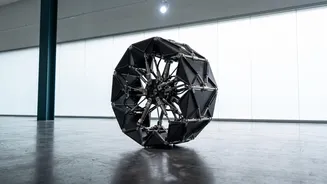
Enter a team of researchers from the Korea Advanced Institute of Science and Technology (KAIST). They've developed a radical new concept: a transformable, airless wheel inspired by the ancient art of origami. Led by Professor Dae-Young Lee of KAIST's Department of Aerospace Engineering, the team created a wheel that can change its size and shape to adapt to its surroundings. This isn't just about making a tougher wheel; it's about making a smarter one. The design allows a small, compact rover to carry wheels that can expand significantly, overcoming obstacles that would otherwise be insurmountable for a vehicle of its size.
How Ancient Art Builds a Better Wheel
The secret lies in applying the geometric principles of origami and a structural concept known as the 'Da Vinci bridge'. Instead of using complex hinges and joints that could seize up in a vacuum or get clogged with abrasive lunar dust, the KAIST wheel uses the inherent flexibility of its materials. It is constructed from elastic metal strips, such as high-carbon steel, arranged in a way that allows the entire structure to fold and unfold. This allows the wheel to be packed compactly, shrinking from a full diameter of 500 mm (about 20 inches) down to just 230 mm (about 9 inches), saving precious cargo space on a lander. Once deployed, it can expand to navigate challenging environments.
Built for a Bruising Lunar Ride
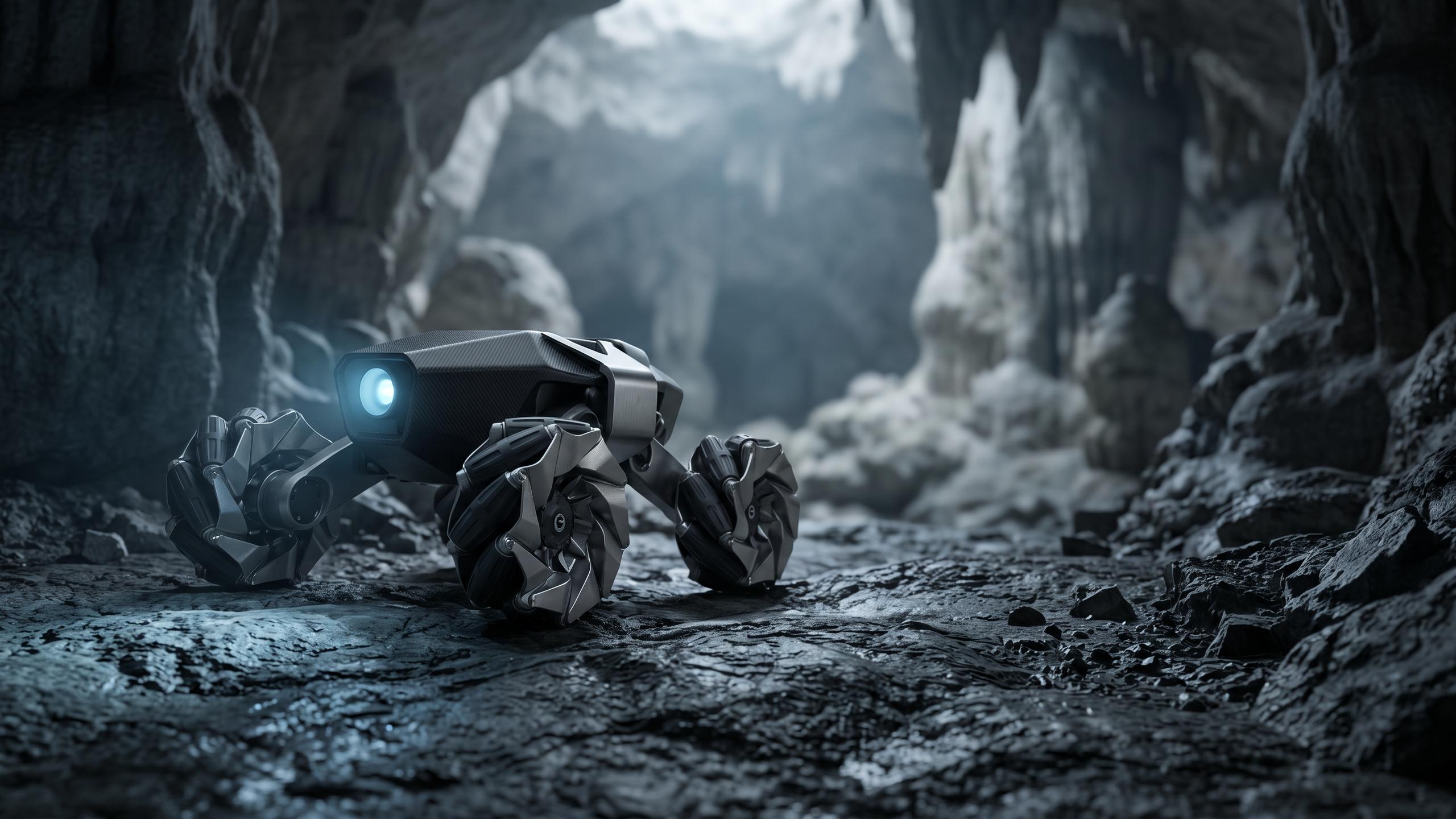
The primary target for this new technology is the Moon, specifically its hazardous lunar pits and lava tubes. These subterranean caves are of huge interest as potential sites for future human bases because they offer natural protection from radiation and extreme temperatures. However, their steep, rugged entrances are perilous. The KAIST wheel is designed to tackle this. By expanding, it increases a rover's ability to climb over large rocks and steep slopes. The soft, compliant structure is also excellent at absorbing shocks. Tests have shown it can withstand impacts equivalent to a 100-meter fall in lunar gravity. Its airless design means no risk of punctures, a critical advantage for mission reliability.
From the Lab to the Lunar Surface
This isn't just a theoretical concept. The joint research team, which includes the private space robotics company Unmanned Exploration Laboratory (UEL), has already put the wheels to the test in environments that mimic lunar conditions, including the lava tubes on South Korea's Jeju Island. The design was validated using mathematical thermal models to ensure it could withstand the Moon's extreme temperature swings, which can be a major stress on mechanical parts. The researchers are optimistic that this unique technology will become a key component of future lunar missions, perhaps even as part of a strategy to deploy swarms of smaller, more resilient rovers instead of a single, large one. This approach could make exploring the most dangerous—and most interesting—parts of the Moon a reality.