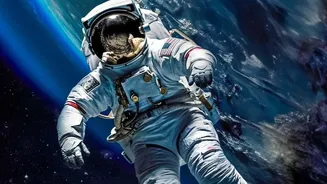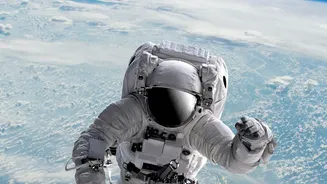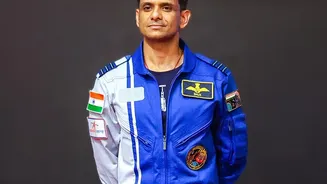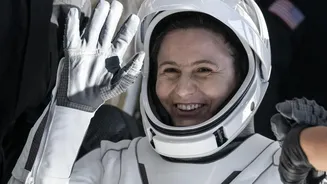






For a few precious seconds, gravity lets go. This is the surreal experience for India's Gaganyaan astronaut candidates, who are learning to master movement in a weightless environment, a critical step towards India's first human spaceflight mission.
The 'Vomit Comet' Rollercoaster
To
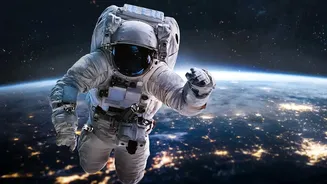
prepare for life in orbit, you first need to learn how to float. This training takes place inside a massive Ilyushin Il-76 MDK aircraft, a flying laboratory operated out of Russia's famed Gagarin Cosmonaut Training Center. Nicknamed the 'vomit comet', this plane achieves brief periods of weightlessness not by leaving the atmosphere, but by flying in a special pattern called a parabolic arc. The aircraft climbs steeply at a 45-degree angle, pushing astronauts against the floor with forces up to twice Earth's gravity. Then, at the peak of its arc around 9,000 metres, the pilots reduce thrust, and the plane enters a controlled freefall. For about 25 to 28 seconds, everything and everyone inside becomes weightless, floating in the cavernous, padded cabin before the plane pulls up and gravity returns with a thud. This rollercoaster-like manoeuvre is repeated up to 15 times in a single flight, giving the crew precious minutes to adapt to a world without up or down.
Why Floating Is Hard Work
While it may look like fun, this training is serious business. In the microgravity of space, the human body is disoriented. Simple actions like moving across a room, handling equipment, or even knowing which way is up become challenging. These parabolic flights are an essential first step, allowing the 'Vyomanauts' (from the Sanskrit word 'Vyoma' for space) to practice body control and spatial awareness. A slight push can send you careening across the cabin. This training helps build muscle memory for an environment that defies all earthly instinct. It's crucial for performing tasks, conducting experiments, and handling potential emergencies once they are in orbit. The training also simulates the weaker gravity of the Moon and Mars, preparing the astronauts for potential future missions by allowing them to experience what it feels like to weigh a fraction of what they do on Earth.
A Partnership Forged in Space
The training highlights the deep and long-standing space cooperation between India and Russia. India's four astronaut-designates—all decorated Indian Air Force test pilots—completed a significant portion of their foundational training at the Gagarin Cosmonaut Training Center near Moscow, the same facility where Rakesh Sharma, the first Indian in space, prepared for his 1984 mission. The 13-month regimen in Russia covered everything from survival training and centrifuge simulations to studying the systems of the Soyuz spacecraft. Russia's space agency, Roscosmos, has been a key partner in the Gaganyaan program, providing assistance not just with training but also with components like crew flight suits and viewing windows. Following their time in Russia, the astronauts have continued their mission-specific training at ISRO's own Astronaut Training Facility in Bengaluru.
The Road to India's First Crewed Flight
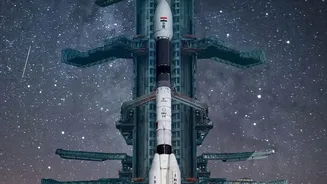
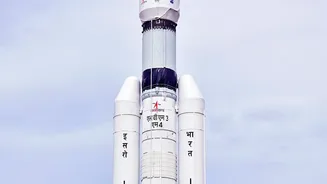
This intensive training is one of many parallel streams of preparation for the Gaganyaan mission, India's ambitious project to send a crew of three into a 400-km orbit for three days and bring them back safely. The Indian Space Research Organisation (ISRO) is meticulously testing every component. Before astronauts fly, ISRO plans several uncrewed test missions. The first, known as G1, will carry a humanoid robot named 'Vyomitra' to validate the performance of the human-rated LVM3 rocket, the life-support systems, and the crew module's re-entry and recovery procedures. While the timeline has seen revisions due to the complexities of human spaceflight and supply chain disruptions, the first uncrewed launch is currently targeted for late 2026 or early 2027, with the first historic crewed mission slated for 2027 or 2028.