
A Tale of Two Galaxies
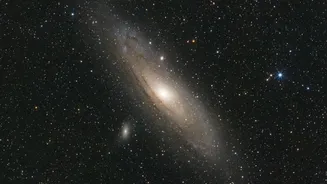
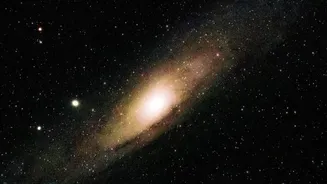
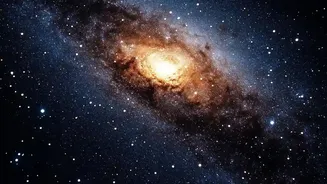
At 2.5 million light-years away, the Andromeda galaxy, or M31, is our closest major galactic neighbor. It is so close that it offers astronomers a unique opportunity: we can see it in incredible detail, resolving millions of individual stars, while also
getting a wide-angle view of its overall structure. This is a perspective we can never get of our own Milky Way, as we are embedded deep within it. For decades, scientists have used Andromeda as a laboratory to test theories of how large spiral galaxies form, grow, and evolve. A major discovery came years ago when it was found that Andromeda experienced a massive burst of star formation about 2 billion years ago, likely from a merger with another galaxy. That event created a huge portion of the stars we see today.
Hubble's Unprecedented Cosmic Map
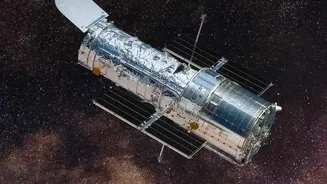
The latest insights come from a colossal effort combining data from two major Hubble surveys: the Panchromatic Hubble Andromeda Treasury (PHAT) and the Panchromatic Hubble Andromeda Southern Treasury (PHAST). Together, these projects created an ultra-sharp map of about two-thirds of Andromeda’s disk, cataloging the light from roughly 200 million individual stars. This is what makes the study so powerful. By analyzing the color of the stars, scientists can create a 'fossil record' of the galaxy's history. Massive, young stars burn hot and appear blue but die quickly, while smaller, older stars are redder and live much longer. By plotting the locations of these different stellar populations, researchers can rewind time and see when and where stars were born.
A Galaxy Quietly Winding Down
The new study, published in The Astrophysical Journal, reveals a clear and steady decline in Andromeda's star-making prowess. Researchers calculated that 500 million years ago, Andromeda was forming stars at a rate of about one solar mass (the mass of our Sun) per year. But that rate began to drop, and by 40 million years ago, it had halved. Today, the galaxy's star formation has plummeted to just one-fifth of a solar mass per year. This suggests Andromeda is not running out of fuel but is in a natural phase of winding down after its more active past. The findings paint a picture of a galaxy that is gracefully aging, moving from a bustling star-forming spiral toward a quieter future.
The Fading Ring of Fire
The decline isn't happening uniformly across the galaxy. The analysis found that much of the recent star-forming activity has been concentrated in a prominent ring of gas and dust located about 32,000 light-years from Andromeda's center. It's the fading activity within this specific ring that is driving much of the overall slowdown. As this once-hyperactive region quiets down, it pulls the entire galaxy's average rate of star birth down with it. This provides a crucial clue for galaxy evolution models, showing that different regions of a galaxy can age at different paces, with star-forming 'hot spots' eventually burning themselves out.
Clues to Our Own Cosmic Future
Because Andromeda is so similar to the Milky Way, studying its life cycle provides invaluable insight into our own galaxy's potential past and future. While our Milky Way is currently more active, producing about 3 to 5 solar masses worth of stars per year, Andromeda's slowdown could be a preview of what lies ahead for us. Furthermore, this research sets the stage for even more detailed work. The upcoming Nancy Grace Roman Space Telescope, with its vastly wider field of view, will be able to survey the entire Andromeda galaxy, building on Hubble's foundation to create an even more complete history of our cosmic neighbor and, by extension, ourselves.