







A World That Continues to Surprise
When NASA's New Horizons spacecraft flew past Pluto in 2015, it transformed our view of the distant world from a blurry point of light into a complex and active body. It revealed towering mountains of water ice, vast plains of frozen nitrogen, and a famous
heart-shaped feature known as Tombaugh Regio. Now, a new study of those very images provides compelling evidence for something scientists once thought impossible on such a cold world: recently flowing liquid. Published in the Planetary Science Journal, the research indicates that Pluto is far from the static, icy ball it was long assumed to be. As Alan Stern, the principal investigator for New Horizons, puts it, "Pluto never stops surprising us."
What the Images Revealed
The focus of the new research is a massive glacier of frozen nitrogen called Sputnik Planitia, which makes up the western lobe of Pluto's 'heart'. The 2015 images showed that the surface of this glacier is divided into city-sized convection cells. Along the boundaries of these cells in the northern part of the plain, scientists identified a network of dark, narrow lines and wider, more diffuse patches. After careful analysis, the research team concluded that these features strongly resemble areas on Earth's own glaciers that have been wetted by liquid, either from rain or from meltwater seeping up from below. To confirm this, researchers compared the New Horizons images with satellite observations of the Greenland ice sheet, which showed similar dark patterns caused by liquid water.
The Case for Liquid Nitrogen
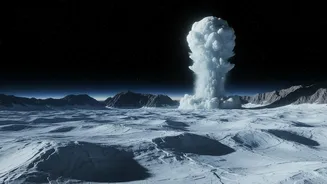
So, what is this liquid? Given Pluto's surface temperature is incredibly cold, liquid water on the surface is not a possibility. Instead, scientists are confident the liquid is nitrogen. But with an atmosphere too thin and cold to produce nitrogen rain, the liquid can't be coming from above. Computer models developed by the research team suggest a fascinating alternative: the immense pressure from the kilometres-deep nitrogen glacier could be sufficient to melt the nitrogen ice at its very base. This liquid nitrogen, being more buoyant than the solid ice above it, could then be forced upward through cracks and fissures in the surface. Once on the surface, it would spread out, 'wetting' the frozen nitrogen ice and darkening it before refreezing, creating the distinct patterns captured by New Horizons.
A Geologically Active World
This discovery is the first evidence of recently flowing liquid on Pluto's surface. The surface of Sputnik Planitia is considered geologically young—likely less than a million years old—meaning these features must have formed recently. The process is unlikely to be a slow, steady trickle. Instead, scientists theorize that the liquid nitrogen builds up in subsurface reservoirs and is released in powerful, short-lived bursts lasting hours or days. This finding adds to a growing body of evidence that Pluto is not a cold, dead world. Previous studies of New Horizons data have already pointed to the existence of cryovolcanoes—ice volcanoes that spew a slurry of ice and water instead of molten rock. Some of these volcanic features also appear to be geologically recent, suggesting Pluto has retained enough internal heat to power widespread geological activity much later in its history than previously thought.