
The Ring of Fire's Hidden Role
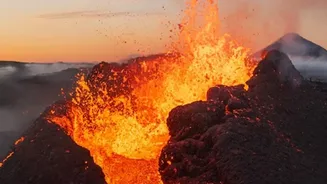
The primary reason for the Pacific's shrinking size lies in what surrounds it: the infamous Ring of Fire. This horseshoe-shaped belt, stretching roughly 40,000 kilometres, is home to about 75% of the world's volcanoes and is responsible for 90% of its
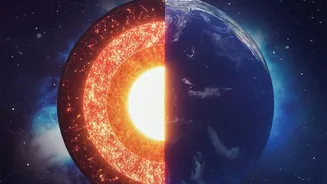
earthquakes. But it's not just a hotbed of seismic activity; it's the site of a massive geological recycling program. The Ring of Fire is essentially a series of subduction zones, areas where the dense oceanic crust of the Pacific Plate is forced to dive, or subduct, beneath the lighter continental plates of Asia, Australia, and the Americas. This process acts like a giant planetary drain, pulling the edges of the ocean floor inward and downward into the Earth's hot mantle, where the old crust is consumed.
The Tug-of-War: Creation vs. Destruction
All oceans exist in a state of constant, albeit slow, change, governed by two competing processes. On one side, you have seafloor spreading. This happens at mid-ocean ridges, like the East Pacific Rise, where tectonic plates pull apart and molten rock from the mantle rises to form new oceanic crust. This process effectively makes an ocean basin wider. On the other side is subduction, the destruction of old crust. The fate of an ocean—whether it grows or shrinks—depends on the balance between these two forces. While the Pacific does have a spreading ridge creating new crust, the rate of destruction along its vast perimeter of subduction zones is far greater. The Atlantic Ocean, by contrast, has very few subduction zones, so its mid-ocean ridge is steadily pushing the Americas away from Europe and Africa, causing the Atlantic to expand.
An Inch at a Time
This geological tug-of-war is not something you would ever notice. The Pacific is shrinking at a rate of about 2.5 centimetres per year. While that may seem minuscule, on a geological timescale, it adds up to a significant transformation. This is the very engine of plate tectonics, the process that has shuffled continents around the globe for billions of years. The constant grinding and sinking of the Pacific Plate at the Ring of Fire is what generates the immense energy released in the region's frequent earthquakes and fuels its many volcanoes. The water from the descending, saturated oceanic crust gets squeezed out, lowering the melting point of the mantle rock above it and creating the magma that feeds volcanic arcs like the Andes and the islands of Japan.
A Glimpse into the Far Future
If this trend continues, what does the deep future hold? Using supercomputer simulations, scientists have forecast that the Pacific Ocean could close completely in the next 200 to 300 million years. As Asia, Australia, and the Americas converge, a new supercontinent is expected to form. Researchers have already given it a name: Amasia, a portmanteau of America and Asia. This is part of Earth's supercontinent cycle, where the planet's landmasses have repeatedly come together and broken apart over hundreds of millions of years. The Pacific, the remnant of a much larger ancient ocean that surrounded the last supercontinent, Pangaea, is simply playing its part in the next phase of this planetary dance.