





Shifting the Search North
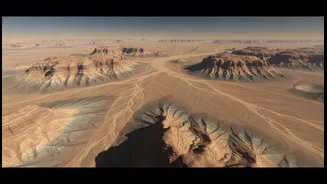
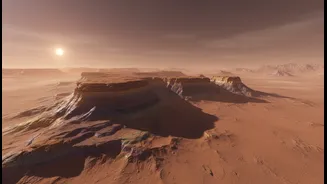
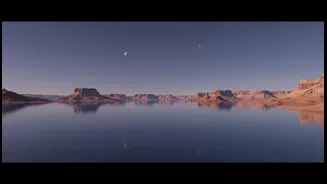
For years, the search for Mars's lost ocean has been a story of frustrating near-misses. Scientists have long theorised that the vast, low-elevation basin covering the planet's northern hemisphere, known as the Vastitas Borealis, was the most likely candidate
for a former seabed. Evidence from ancient river valleys and outflow channels suggested immense floods once poured into this region. Yet, finding a definitive, consistent 'bathtub ring'—a clear shoreline at a constant elevation—has proven difficult. Past claims of shorelines have been contested, with some features later identified as volcanic ridges or other geological formations. This ambiguity has kept the Martian ocean hypothesis in the realm of heated debate. But recent studies are shifting the focus from the contested edges to the deposits lying within the basin itself, and the clues are compelling.
A 'Continental Shelf' on Mars?
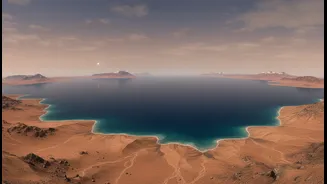
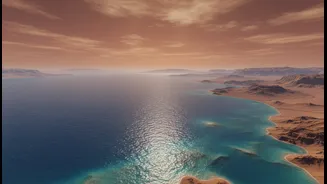
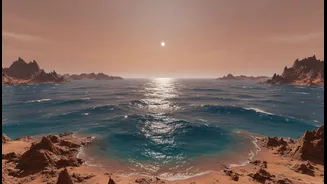
One of the most exciting recent discoveries comes from researchers who decided to look for a different kind of feature. Instead of a subtle shoreline, they searched for a massive geological structure analogous to the continental shelves we see on Earth. By modeling what Earth would look like if our oceans were removed, they identified that a wide, flat shelf is one of the most stable and enduring signs of a former ocean basin. Using topographic data from Mars orbiters, they found a similar feature: a broad band of land ringing the northern lowlands that strongly suggests the presence of a stable, ancient ocean that may have covered a third of the planet. A structure of this scale would have taken a very long time to form, pointing not just to water, but to a persistent ocean that may have existed for millions of years.
Reading the Subsurface Story
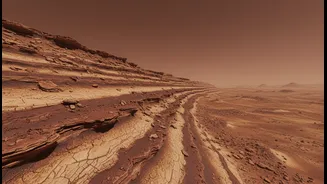
The evidence isn't just on the surface. Data from the ground-penetrating radar on China's Zhurong rover has provided a literal look beneath the dust of Utopia Planitia, a large plain within the northern lowlands. The rover's radar detected extensive, buried layers of sediment dipping in a way that is consistent with a prograding shoreline, where a river or coast deposits material into a large body of water. These underground structures, found along a traverse of over a kilometre, resemble coastal deposits on Earth and are difficult to explain by other means like wind or volcanism. Similarly, other studies have analysed boulder fields within the Vastitas Borealis Formation, concluding they may have been catastrophically deposited by underwater mass-transport events, similar to those in deep-water environments on Earth.
River Deltas Tell the Tale
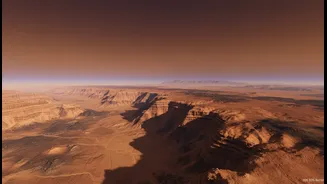
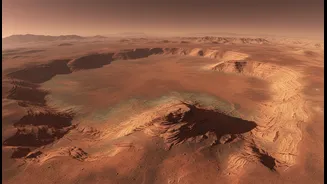
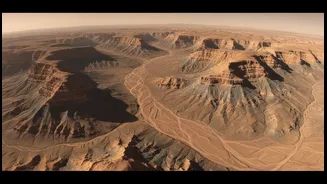
Further strengthening the case, scientists using high-resolution imagery from several orbiters have identified what appear to be ancient river deltas. One study focused on the massive Valles Marineris canyon system found fan-shaped deposits at its mouth that are interpreted as deltas where rivers emptied into a standing body of water. Crucially, the elevations of these delta features align with the proposed shoreline of the northern ocean. These are not just signs of flowing water, but signs of rivers terminating into a massive basin—an ocean. The findings suggest an active hydrological cycle existed on Mars around three billion years ago, with rivers transporting sediment from the highlands into a sea that may have been as large as our own Arctic Ocean.
The Ultimate Prize: A Habitable Past
Proving the existence of a long-standing ocean on Mars has profound implications for its potential past habitability. While the Mars of today is a frozen desert, a past with a vast, stable body of liquid water suggests a much warmer and wetter climate billions of years ago. Such environments are prime candidates in the search for extraterrestrial life. Coastal sediments and ancient seafloors are excellent places to preserve biosignatures, the chemical or fossilised traces of past life. These new findings are helping scientists identify promising new targets for future rovers and missions, which could one day drill into these shoreline deposits and analyse them for signs that Mars was once not just a watery world, but a living one.