



A Sweet Discovery in Deep Space
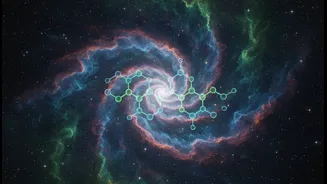
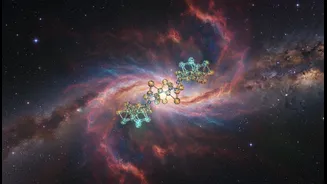
Astronomers have detected the chemical fingerprint of erythrulose, a four-carbon sugar, in a vast molecular cloud known as G+0.693-0.027, located thousands of light-years away near the center of the Milky Way. Using powerful radio telescopes in Spain,
an international team of scientists identified the specific signals emitted by this molecule, confirming its presence in the frigid, sparse environment between the stars. This marks the first time a 'true sugar' of this complexity has been directly detected in interstellar space. While simpler sugar-like molecules had been found before, and more complex sugars like ribose were found in meteorites, finding erythrulose freely floating in a pre-stellar cloud is a significant leap. It suggests that the universe has been baking some of life's key ingredients long before there were planets to host it.
Why This Tiny Molecule Matters
On its own, erythrulose might not seem revolutionary. On Earth, it is a simple sugar found in things like red raspberries. However, its presence in space is profoundly important for theories on the origin of life. Sugars are crucial building blocks for life as we know it. Most famously, a five-carbon sugar called ribose forms the backbone of RNA (ribonucleic acid). Many scientists subscribe to the "RNA World" hypothesis, which posits that RNA, not DNA, was the original genetic material on early Earth because it can both store information and catalyze reactions. The big question has always been: where did the ribose come from? Laboratory experiments have struggled to create these sugars in the quantities needed under early Earth conditions. The discovery of erythrulose provides a potential answer. As a four-carbon sugar, it is considered a key chemical stepping stone, a precursor that can lead to the formation of more complex five-carbon sugars like ribose.
Chemistry Before the Solar System
The detection of erythrulose in a molecular cloud—a stellar nursery where stars and planets are born—fundamentally changes our timeline for prebiotic chemistry. It demonstrates that the formation of complex organic molecules isn't something that had to happen on the surface of a young, rocky planet like Earth. Instead, this chemistry is happening out in the galaxy, on the surfaces of tiny, frozen dust grains. These molecules can form from even simpler compounds, which are abundant in space. This means that when our solar system began to form from a similar cloud of gas and dust, it likely inherited a rich inventory of life's building blocks. Rather than starting from scratch, early Earth was likely seeded with these essential compounds. Scientists estimate that millions of tonnes of erythrulose could have been delivered to our planet during the Late Heavy Bombardment, a period when Earth was frequently struck by comets and asteroids.
A Universal Recipe for Life?
This discovery does not mean we have found alien life. What it does, however, is strengthen the argument that the potential for life might be widespread in the universe. If the essential ingredients for life—amino acids, nucleobases, and now complex sugars—are not a unique feature of our planet but are common in interstellar space, it suggests that the chemical pathway to life could be a universal one. Finding erythrulose gives scientists confidence that other, even more complex sugars like ribose are also likely present in these cosmic clouds, waiting to be detected. The search for our origins, it turns out, is not just about looking down at the rocks beneath our feet, but also about looking up at the space between the stars.