







Earth’s Churning Engine
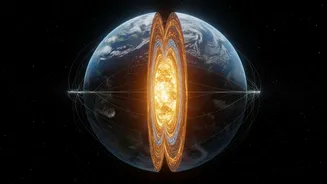
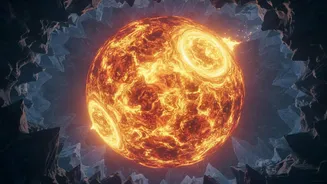
Deep within our planet lies a core with two parts: a solid iron ball at the very centre, about the size of the moon, and a turbulent, liquid outer core surrounding it. This outer core, a superheated ocean of liquid iron and nickel about 2,200 kilometres
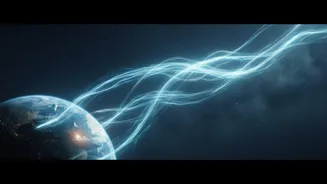
thick, is not static. Its constant, churning motion acts like a giant dynamo, generating powerful electric currents. These currents, in turn, produce Earth's magnetic field, an invisible force field that is crucial for life. This magnetic shield extends far out into space, protecting us from harmful solar radiation and cosmic rays that would otherwise strip away our atmosphere. Without it, life as we know it could not exist.
Eyes in the Sky
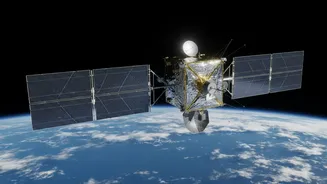
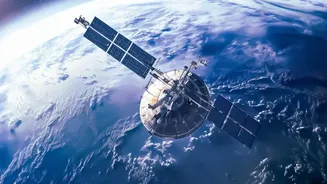
For obvious reasons, we can't send a probe to the core. Scientists must study it indirectly, and one of the best ways is by observing the magnetic field it generates. This is where satellites become our remote-sensing detectives. The European Space Agency’s (ESA) Swarm mission, a trio of satellites launched in 2013, is at the forefront of this effort. Each satellite is equipped with highly sensitive instruments called magnetometers, which measure the strength and direction of the magnetic field with incredible precision. By flying in a specific formation, the Swarm constellation can untangle the magnetic signals coming from the core from other sources like the crust, oceans, and atmosphere, giving us an unprecedentedly clear picture of the deep Earth.
A Sudden Reversal
By analysing years of data from Swarm and other missions, scientists uncovered a dramatic event. For years, a significant portion of the core's flow had been moving generally westward. But around 2010, a massive section of this molten river deep beneath the Pacific Ocean did an about-face. It began flowing strongly eastward, a sudden and unexpected reversal. This isn't like a river on the surface changing course; it's a colossal shift in a planetary-scale system. The reasons for this change are still a mystery to scientists, challenging previous assumptions that the core's circulation was relatively stable.
Why This Discovery Matters
This discovery doesn't signal an impending doomsday. These processes occur far below the surface and pose no direct danger. However, they are fundamentally important to understanding how our planet works. The flow reversal has been linked to other observable phenomena, like a 'geomagnetic jerk' in 2017—a sudden, sharp change in the magnetic field's behaviour. Studying these events helps scientists refine their models of the geodynamo, the engine that powers our planetary shield. A better understanding of the core's behaviour can improve our ability to predict changes in the magnetic field. This has practical implications for everything from smartphone navigation to the operation of satellites and the stability of power grids.
A Glimpse into the Future
So, what happens now? The latest data suggests the eastward surge has been weakening since peaking around 2020, raising the possibility that this reversal is part of a longer, natural cycle or oscillation that we are only now beginning to observe. Some scientists have even hypothesised a link between this flow change in the outer core and a recently detected slowing in the rotation of the solid inner core, suggesting a deep connection between Earth's innermost layers. Continued monitoring by the Swarm satellites will be crucial to see how the flow evolves and to unravel the complex dynamics hidden deep within our world.