




A Tale of Two Fates
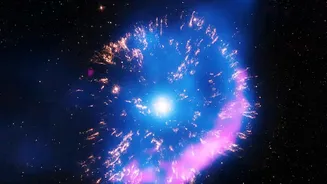
Imagine a star many times more massive than our Sun running out of fuel. Its core, no longer able to support its own immense weight, collapses in on itself in a fraction of a second. This catastrophic event has two potential outcomes. If the inward collapse rebounds
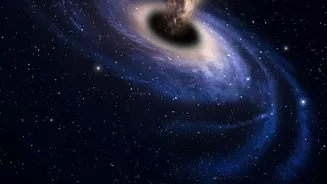
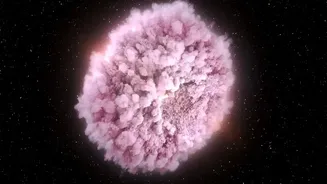
and triggers a runaway explosion, we see a supernova, one of the most luminous events in the universe. This explosion seeds the cosmos with heavy elements essential for forming planets and life. If the rebound fails, however, the star continues to collapse, forming a black hole that swallows everything, including light and any newly forged elements. A new study from the University of Copenhagen suggests the deciding factor might be the behaviour of the tiniest, most elusive particles involved.
The Ghost Particle's Role
The key players are neutrinos, often called 'ghost particles'. These fundamental particles are almost massless, have no electric charge, and barely interact with other matter. Trillions pass through your body every second without you noticing. During a star's core collapse, an unimaginable number of them are created, carrying away about 99% of the event's energy. For a long time, astrophysicists thought the specifics of these neutrinos were a secondary detail. The new research challenges this. It focuses on 'neutrino flavor conversion'—the ability of neutrinos to switch between their three types (electron, muon, and tau) as they travel. This change, once considered a minor quirk, now appears to be a master switch for the star's fate.
The Power of 195 Simulations
The breakthrough comes from a massive computational effort. Simulating the physics inside a collapsing star is incredibly complex and expensive, pushing supercomputers to their limits. Previous studies could only model a few stars or had to simplify the physics. A team led by researchers Mariam Gogilashvili and Irene Tamborra simulated the collapse of 195 different stars, with masses ranging from 9 to 120 times that of our Sun. For each star, they ran simulations both with and without including the effects of neutrino flavor conversion. This comprehensive approach allowed them to see clear patterns that were invisible before.
Flipping the Cosmic Switch
The results were dramatic. The simulations showed that including neutrino flavor conversion could completely flip the outcome for a whole range of stars. Specifically, for stars between 16 and 30 times the mass of the Sun, the effect was profound. Stars that were predicted to explode into supernovae in simpler models instead failed to explode and collapsed directly into black holes when flavor conversion was accounted for. This is because the flavor of a neutrino determines how it interacts with the material around the star's core. By changing the balance of flavors, the process alters how effectively neutrinos can deposit their energy to power an explosion. This discovery helps explain a long-standing mystery known as the 'supernova rate problem'—why astronomers observe fewer supernovae in the universe than older models predicted.