





The Fading Heartbeat of a Legend
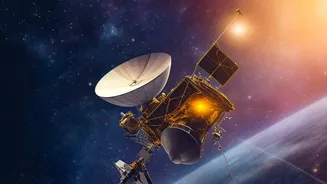
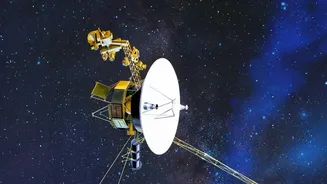
Imagine running a machine that was built almost half a century ago. Now imagine that machine is billions of kilometres away, hurtling through the space between stars. That’s the daily reality for the engineers managing NASA's Voyager 2. Launched in 1977,
the probe relies on three Radioisotope Thermoelectric Generators (RTGs), which convert heat from decaying plutonium into electricity. This isn’t a flaw; it’s physics. The plutonium’s heat output naturally diminishes, reducing the spacecraft’s available power by about four watts each year. For decades, this slow decline wasn’t a major issue, but after nearly five decades of continuous operation, the power margins have become razor-thin. Engineers have been forced to make tough decisions, powering down systems and even science instruments just to keep the mission alive.
An Interstellar 'Big Bang'
Faced with shutting down yet another of Voyager 2’s precious few remaining science instruments before the end of 2026, the mission team at NASA's Jet Propulsion Laboratory (JPL) executed a daring plan nicknamed the “Big Bang”. The maneuver involved sending commands to simultaneously switch off several powered components and replace them with lower-power alternatives that were already on board. The swap was a delicate balancing act. They needed to save watts without letting the spacecraft get too cold, which could damage its systems in the near-absolute-zero temperatures of deep space. The successful maneuver freed up just enough energy to keep all its remaining science operations going. It’s a testament to the ingenuity of the team and the robust design of a machine from the 1970s.
The Science We Can't Get Anywhere Else
The power-saving effort was crucial because it protected the mission's primary goal: science. This new lease on life means Voyager 2’s three remaining active instrument suites can continue operating for at least another year. These aren’t just any instruments; they are our only direct connection to the interstellar medium. The Cosmic Ray Subsystem measures energetic particles from beyond our solar system, the Magnetometer studies the magnetic fields that permeate deep space, and the Plasma Wave Subsystem listens for the hum of plasma waves. These instruments were once part of a larger suite of ten. In recent years, instruments like the Plasma Spectrometer and the Low-Energy Charged Particle detector were reluctantly turned off to conserve power. Every extra day of data from the remaining trio provides invaluable information about the environment outside the protective bubble of our Sun, a region humanity has only just begun to explore.
A Mission Beyond All Expectations
When Voyager 2 launched, its primary mission was a four-year “Grand Tour” of Jupiter and Saturn. It wildly exceeded that goal, going on to become the only spacecraft in history to visit Uranus and Neptune. It completed its planetary mission in 1989 and began its journey toward the stars. In 2018, it officially crossed the heliopause, the boundary where the Sun's influence gives way to interstellar space. This isn't the first time engineers have found a creative way to extend the mission. In 2023, they began drawing power from a small reservoir originally intended for an onboard safety mechanism, a move that kept all five of its then-active instruments running longer than expected. This latest “Big Bang” maneuver is another chapter in the story of a mission that has become one of humanity’s greatest feats of exploration and engineering endurance.