
A Partial But Monumental Success
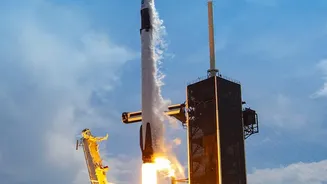
The 15th test flight of the world's most powerful rocket system was a mission of immense ambition: to launch, deliver a payload to orbit, and then recover both the Super Heavy booster and the Starship upper stage by catching them with the launch tower's
mechanical arms. While the full 'double catch' was not achieved, the mission was a resounding success. The Super Heavy booster, after propelling the ship skyward, experienced an issue with low fuel during its boostback burn and was safely diverted for a splashdown in the Gulf of Mexico. However, the main prize was secured. The Starship spacecraft completed its primary mission, spending over 22 hours in orbit, completing 14 circuits of the Earth and deploying 26 Starlink satellites before heading home.
The High-Stakes Space Ballet
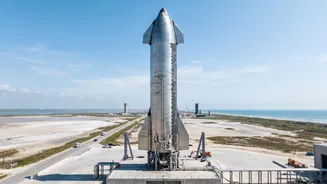
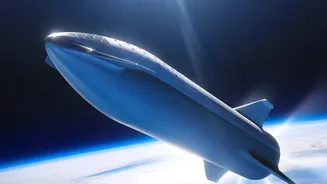
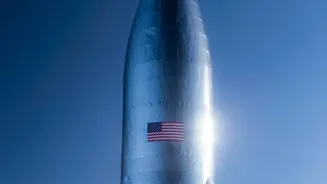
The return sequence was a breathtaking display of precision. After deorbiting, the 52-metre-tall spacecraft screamed back into the atmosphere, protected from extreme temperatures by its thousands of black hexagonal heat shield tiles. It performed a now-famous 'belly-flop' maneuver to scrub off speed before reorienting itself to a vertical position for the final descent. Firing its powerful Raptor engines, it slowed to a near-hover over the launch site at Starbase, Texas. Then, the giant mechanical arms of the launch tower, nicknamed 'Mechazilla', moved into position and closed around the spacecraft, securing it in a firm embrace just above the ground. The maneuver, described by a SpaceX spokesperson as the 'holy grail of spaceflight', had never been successfully performed on an orbital-class upper stage before.
Why the Catch Changes Everything
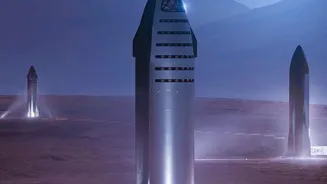
Catching the booster and ship is not just a spectacle; it is the core of SpaceX's entire business model for Starship. The goal is airplane-like reusability. Landing a rocket at sea on a drone ship, as the Falcon 9 often does, requires a lengthy and costly recovery process. Catching the vehicle directly on the launch tower eliminates transport time and dramatically shortens the turnaround for the next flight. This rapid reusability is what could slash the cost of accessing space, enabling SpaceX to launch massive satellite constellations and, eventually, fleets of ships to the Moon and Mars. A vehicle that can be caught, inspected, refueled, and relaunched in hours or days instead of weeks or months fundamentally changes the economics of space travel.
The Tower of Power: 'Mechazilla' Explained
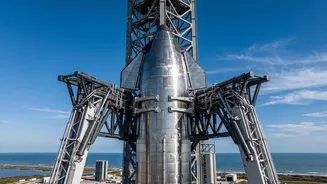
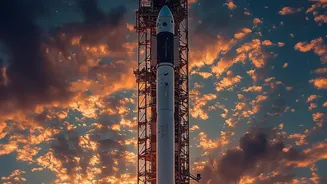
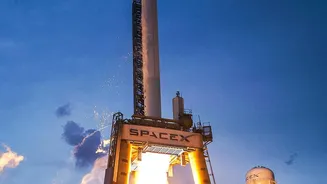
The launch and catch tower is an engineering marvel in its own right. Standing over 400 feet tall, the structure serves a dual purpose: launching the rocket and recovering it. Its most prominent features are the two giant 'chopstick' arms. These are powered by complex hydraulic systems and guided by an array of sensors, cameras, and LiDAR to track the returning rocket with centimetre-level precision. The system is designed to absorb the immense forces of catching a multi-ton vehicle descending from the sky. Before this flight, SpaceX had already successfully caught the Super Heavy booster on three previous occasions, proving the fundamental concept. This first catch of the faster, higher-flying upper stage was the next critical step.
What Happens Next?
With the successful recovery of a Starship, SpaceX engineers can now perform detailed inspections to see how the vehicle, particularly its heat shield, fared during its orbital journey and fiery reentry. The next major milestones will be to investigate and solve the issue that prevented the booster catch, achieve a 'double catch' of both the booster and ship on a single flight, and then, most importantly, refurbish and refly a recovered Starship. This successful catch is also a crucial step for NASA's Artemis program, which has selected Starship to be the vehicle that will land astronauts on the Moon. While orbital refueling and life support systems still need to be perfected, proving that the vehicle can return safely to its launch pad is a massive leap forward.