

A Glimpse of a Dying Star
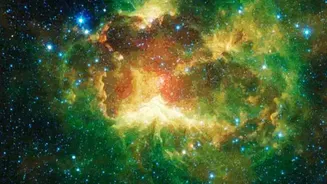
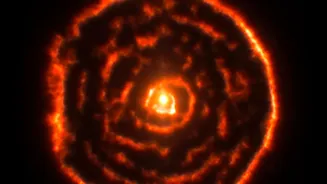
The Lion Nebula, formally known as NGC 2392, is what astronomers call a planetary nebula. This has nothing to do with planets; it’s the beautiful, glowing shroud of gas and dust cast off by a star similar to our sun at the end of its life. As the star ran
out of fuel, it shed its outer layers into space. At the nebula's heart, a scorching hot stellar remnant called a white dwarf now illuminates these expanding shells, creating the spectacular sight we see today. While Hubble previously imaged the nebula, Webb's infrared vision cuts through the haze to reveal its structure with far greater clarity.
Webb’s Infrared Investigation
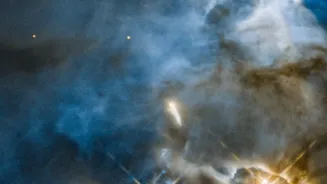
What makes Webb’s view so revolutionary is its ability to see in infrared light. This allows it to peer through obscuring layers and detect the faint heat signatures of different materials. In its portrait of the Lion Nebula, Webb's combined Near-Infrared Camera (NIRCam) and Mid-Infrared Instrument (MIRI) highlight features that were previously hidden. The lion’s 'face' is a bubble of superheated, ionized gas being pushed outward by the central star's fierce radiation. The flowing 'mane' is composed of more complex structures, including delicate filaments and dense clumps of dust.
The Mystery of the Resilient Dust
This brings us to the central clue in the new image: the dust clumps. The environment around a white dwarf is incredibly hostile, with intense radiation blasting away at everything in its path. Logically, tiny dust grains should be destroyed in this cosmic furnace. Yet, Webb’s image clearly shows dense clumps of dust surviving within the lion’s mane, appearing as reddish and orange features. These clumps are not only withstanding the onslaught but are also acting as shields, protecting the material located behind them. How these structures manage to hold together has been a significant question for astronomers.
New Clues to an Old Puzzle
The new data suggests these clumps are denser than previously thought, allowing them to resist erosion from the stellar radiation. The composition of this dust is also key. Many such nebulae contain complex organic molecules known as polycyclic aromatic hydrocarbons (PAHs), which are very sturdy. These carbon-based molecules are efficient at absorbing high-energy light and re-radiating it at safer, lower-energy infrared wavelengths, which helps them survive. Webb’s instruments are perfectly tuned to detect these PAH signatures, and their presence helps explain how these dusty structures can persist. The images show that in some oxygen-rich nebulae, conditions can still allow for the formation of large carbon molecules.
Why Dust Clumps Matter
Understanding how dust survives is about more than just one nebula. Cosmic dust isn't just cosmic lint; it’s the raw material for future generations of stars and planets. The universe is a grand recycling system: dying stars enrich space with new elements and dust, which then gathers in new clouds to form stellar nurseries. If dust couldn't survive the final phases of a star's life, there would be less material available to build new worlds. By studying the Lion Nebula, scientists gain crucial insights into the lifecycle of cosmic matter, helping them refine theories on how everything from asteroids to planets like Earth originally formed. This single snapshot captures a key moment in the ongoing cosmic story of creation and destruction.