




The Decisive Test Trio
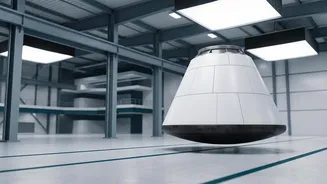
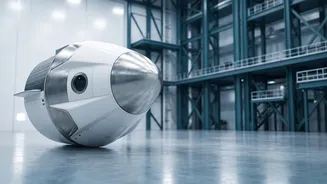
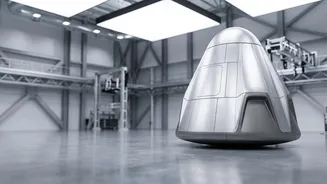
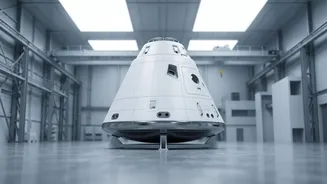
The Indian Space Research Organisation (ISRO) recently announced the successful completion of three major qualification tests for the Gaganyaan crew module, the capsule where Indian astronauts, or 'vyomanauts', will be housed. These weren't just routine
checks; they were high-stakes evaluations of systems that must perform flawlessly during the mission's most perilous phases. The tests focused on three distinct, crucial moments that are entirely out of the astronauts' control: the capsule's stability after splashdown, its clean separation from the service module before re-entry, and its ability to withstand the powerful forces of parachute deployment. By validating these systems, ISRO has moved one significant step closer to ensuring the crew can return to Earth safely.
Ensuring a Safe Splashdown
One of the most critical tests was for the Crew Module Up-righting System (CMUS). After a fiery re-entry through the atmosphere, the Gaganyaan capsule is designed to splash down in the ocean. However, there's a risk of it landing upside down or at a dangerous angle in the water. To counter this, ISRO has developed a system using stored cold gas to rapidly inflate flotation bags. The successful test demonstrated that this system can quickly and reliably turn the module back to its correct, upright position, ensuring the crew remains safe and stable while awaiting recovery by naval teams.
Separation and Structural Strength
Another test focused on the Crew Module-Service Module Connect and Disconnect System (CS-CDS). The service module provides power and life support during the mission, but it must be cleanly jettisoned before the crew module begins its descent. This test validated the umbilical separation, ensuring no-snag disengagement. The third trial was a structural qualification for the Apex Cover separation. This cover protects the main parachutes. During the test, the crew module's structure was subjected to forces approximately 1.75 times higher than what's expected during flight to confirm its integrity when the parachute cover is blasted away. Passing these tests confirms the capsule is robust enough to handle the violent, pre-programmed events of re-entry.
A Culture of Safety First
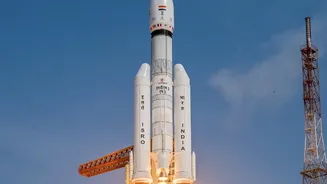
These qualification tests are part of a much broader safety-first philosophy for the Gaganyaan mission. The human-rated launch vehicle, HLVM3, is equipped with a Crew Escape System (CES). This system is designed to act like a powerful ejection seat for the entire capsule, using solid-fuel motors to pull the crew to safety in case of a launch anomaly on the pad or during ascent. ISRO has already conducted several successful demonstrations, including a Pad Abort Test and a high-altitude abort test (TV-D1), which proved the system's ability to function under stressful conditions. Furthermore, the capsule's descent is managed by a complex 10-parachute system designed to slow it from over 216 m/s to a gentle 11 m/s at splashdown. Multiple air-drop tests have been conducted to validate this crucial deceleration system.
The Road Ahead
With these milestones achieved, the path is clearing for the next phase of the Gaganyaan programme. Before any humans fly, ISRO is planning a series of uncrewed test missions. The first, designated G1, is expected to fly with a humanoid robot named Vyommitra to test life-support and other systems in a real space environment. These robotic flights will provide invaluable data and allow ISRO to fine-tune every aspect of the mission profile. The astronaut candidates have already completed generic training and are now undergoing mission-specific instruction in Bengaluru. Only after a series of successful uncrewed flights will India's first human-crewed mission, H1, get the final green light, with a potential launch in 2027.