

A Treasure in the Salt Plains
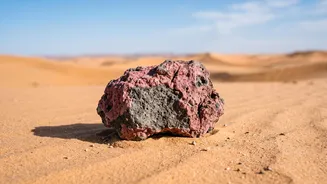
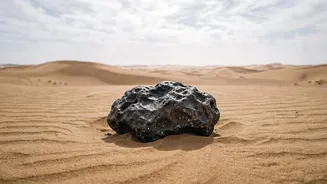
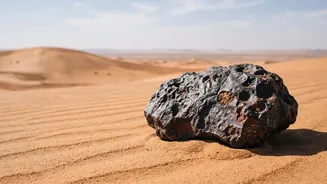
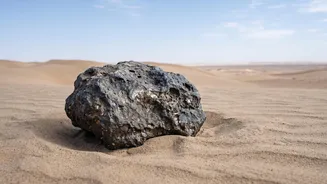
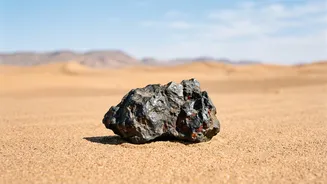
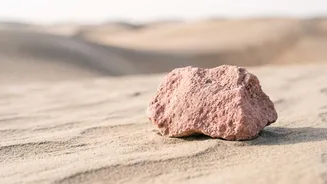
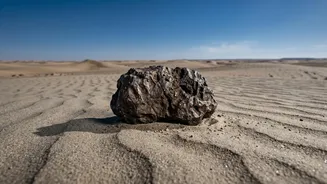
The Sahara Desert is a prime location for meteorite hunters. Its dry climate preserves fallen space rocks for millennia, and the sparse, sandy landscape makes dark stones stand out. In 2022, on a salt plain in Mali named Teghaza, meteorite hunters found
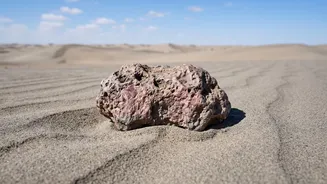
a prize: several fragments of a distinctive, almost rose-coloured rock. The pieces, weighing nearly 800 grams in total, were eventually acquired by collectors and dealers, beginning a journey that would take them from the African desert to the world's most advanced scientific laboratories. This path, common for such discoveries, often means there is a significant delay between when a meteorite is found and when it can be scientifically analyzed.
Confirming a Martian Origin
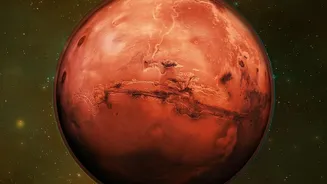
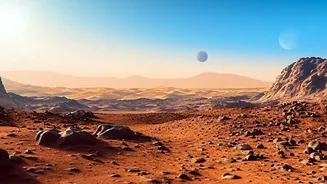
How do scientists know a rock came from Mars? The proof lies in its chemistry. A cataclysmic asteroid impact on Mars millions of years ago can blast surface rocks into space with enough force to escape the planet's gravity. Some of these rocks eventually fall to Earth. Crucially, some Martian meteorites contain tiny pockets of trapped gas. When scientists analyzed these gases in past samples, they found a perfect match for the atmospheric composition of Mars, as measured by NASA's Viking landers in the 1970s. For the Malian meteorite, officially named Teghaza 001, researchers at the University of New Mexico confirmed its origin by analyzing its oxygen isotopes, which act like a geochemical fingerprint unique to different planetary bodies.
A 'Rosetta Stone' for Mars
When Dr. Yang Liu of NASA's Jet Propulsion Laboratory was first asked to study Teghaza 001, she nearly declined. It was initially classified as a shergottite, the most common type of Martian meteorite. However, a closer look revealed textures and minerals she had never seen before. The rock contained a unique mix of volcanic minerals, including zircon crystals. These tiny, durable crystals are a gift to geologists because they can be precisely dated. The analysis, published in the journal 'Science' in late 2026, delivered a shock: the rock had been altered by water on Mars at least 4.1 billion years ago, meaning the rock itself was even older. One reviewer of the study called it a 'Rosetta Stone for Mars' for its potential to unlock the planet's ancient secrets.
A Window Into a Watery Past
Teghaza 001 is one of the three oldest Martian meteorites ever found. Unlike the others, its complex mineralogy tells a two-part story: first, how the planet's crust formed from cooling magma, and second, how it was later altered by subsurface water. This suggests that early Mars had a more dynamic water cycle than previously thought. The meteorite's composition closely matches observations by NASA's Mars Reconnaissance Orbiter of the planet's southern highlands, a heavily cratered and ancient region. This means Teghaza 001 is the first sample we have from a part of the Martian crust that was previously unsampled, offering an unprecedented look at the planet's formative years.