


A Galactic Cold Case Solved
For years, astronomers have been puzzled by a strange feature of our galaxy. While the stars in the Milky Way’s main disk, including our Sun, orbit the galactic center at a brisk 220 kilometers per second, the stars in the vast, spherical cloud surrounding
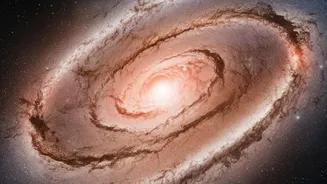
it—known as the stellar halo—move much more slowly. This halo, a sparse collection of ancient stars, rotates at a comparative crawl, a discrepancy that didn't quite add up. New research presented in July 2026 provides a dramatic explanation. Using powerful supercomputer simulations, astronomers from Durham University have concluded that this slow rotation is the lasting signature of a monumental event: a head-on collision that reoriented our entire galaxy.
The Prime Suspect: Gaia-Sausage-Enceladus
The culprit behind this cosmic upheaval is a dwarf galaxy known by the unusual name Gaia-Sausage-Enceladus. This galaxy, though smaller than the Milky Way, was still immense, containing gas, stars, and dark matter equivalent to over 10 billion times the mass of our Sun. Roughly 10 to 11 billion years ago, long before our solar system formed, this intruder slammed directly into the young Milky Way. The collision was so powerful that our galaxy tore the interloper apart, absorbing its stars. The name 'Sausage' comes from the elongated, sausage-like orbits that these captured stars still follow today, a key piece of evidence first uncovered by the European Space Agency's Gaia mission in 2018.
What Does a 'Flipped' Galaxy Mean?
The term 'flipped' isn't just a metaphor. The simulations suggest that the sheer force of the head-on collision exerted a powerful gravitational torque on the Milky Way’s spinning disk of stars. Over a period of a few hundred million years, this force caused the entire disk to slowly tilt, eventually reorienting itself by more than 90 degrees. Imagine a spinning frisbee being struck on its edge and gradually wobbling until it settles into a new orientation. This galactic somersault would have completely changed the layout of our cosmic neighborhood. The slow-moving halo we see today is the leftover evidence of this ancient chaos, a mixture of debris from the Gaia-Sausage galaxy and pre-existing stars whose orbits were scrambled by the event.
Rewriting Our Cosmic History
This discovery does more than just solve the puzzle of the slow halo; it fundamentally changes our understanding of the Milky Way’s evolution. It paints a picture of a dynamic and violent youth, rather than a placid, steady growth. The collision with Gaia-Sausage-Enceladus is now seen as the last major merger in our galaxy's history, an event that helped shape the central bulge of stars and build out the halo we observe today. Furthermore, the research implies that the paths of most stars, potentially even our own Sun, were once drastically different. The 'stable' place we occupy in the galaxy might not have been so stable throughout its entire lifetime, reminding us that the cosmos is in a constant state of change.