







A Landmark Launch with a Twist
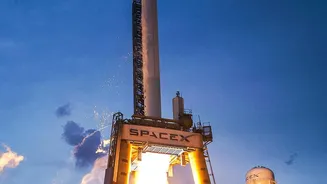
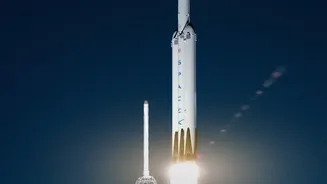
On Monday, September 28, the world's most powerful rocket, Starship, lifted off from its Starbase facility in Texas for its 14th test flight. For the first time, the mission's goal was not just to reach the edge of space, but to enter a sustained orbit
around Earth. The initial ascent was a success, with the Super Heavy booster firing its engines and performing the 'hot-staging' separation maneuver as planned. However, during the upper stage's own ascent burn, one of its six powerful Raptor engines shut down prematurely. This created a moment of high drama in SpaceX's mission control, as engineers quickly assessed whether the flight could continue toward its orbital goal. After a few tense minutes, the team gave the 'go' to proceed. The remaining engines fired for longer to compensate for the lost thrust, successfully pushing the vehicle into its planned trajectory and, ultimately, into orbit for the first time.
Success Through Imperfection
While an engine failure might sound like a major problem, the flight was widely hailed as a landmark achievement. This is central to SpaceX's iterative design philosophy: test, fail, learn, and fly again. The primary goal of these early flights is not perfection, but data. The fact that Starship could lose an engine and still achieve its primary objective of reaching orbit demonstrated the vehicle's robustness. The mission also carried its first operational payload: a batch of 26 next-generation Starlink V3 satellites, which it successfully deployed. Originally, the flight was planned to last nearly ten hours and complete six orbits. However, out of an abundance of caution following the engine anomaly, SpaceX decided to cut the mission short. After about three hours, Starship performed a deorbit burn and executed a controlled splashdown in the Pacific Ocean.
NASA's High-Stakes Bet on Starship
Watching the flight with keen interest was NASA. The American space agency has a multi-billion dollar contract with SpaceX to develop a lunar lander version of Starship, known as the Human Landing System (HLS). This vehicle is critical to its Artemis program, which aims to return astronauts to the Moon for the first time since the Apollo era, with a landing now anticipated no earlier than 2028. The plan calls for astronauts to launch in NASA's Orion capsule, rendezvous with a waiting Starship HLS in lunar orbit, and then use Starship to descend to and ascend from the Moon's surface. Therefore, every Starship test flight, even an uncrewed one, is a crucial step toward proving the vehicle is safe and reliable enough for humans. An engine failure on a test flight provides valuable data, but also underscores the engineering challenges that remain before Starship can be certified for carrying astronauts.
What Comes Next for the Lunar Rocket
The successful, if abbreviated, 14th flight paves the way for even more ambitious tests. The data gathered on the engine performance, orbital insertion, atmospheric reentry, and splashdown will inform upgrades for future vehicles. While this flight did not attempt to recover either the Super Heavy booster or the Starship upper stage, full and rapid reusability remains the program's ultimate goal. Future flights will see SpaceX attempt to catch the returning vehicles with the giant mechanical arms of its launch tower, a maneuver essential for achieving the high flight cadence needed for both its Starlink business and deep-space missions. For NASA, the success of Flight 14 keeps the Artemis timeline on track, but the pressure is on SpaceX to resolve engine reliability issues and demonstrate the flawless performance required for human spaceflight.