



India's Aditya-L1 mission is rewriting our understanding of the Sun. A recent study has revealed that massive solar eruptions don't expand like perfect bubbles, but can be tilted and uneven, a discovery with major implications for Earth.
India's Eye on the Sun
Launched in September
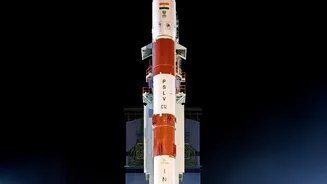
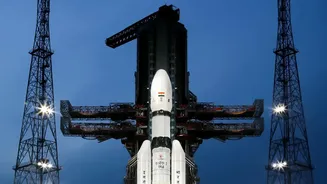
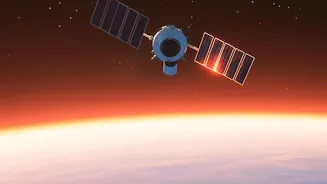
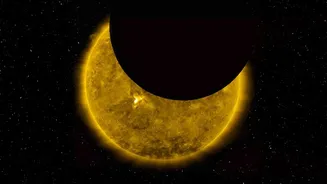
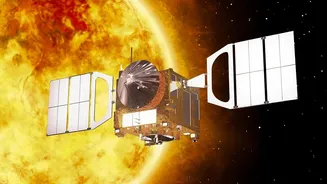
2023, Aditya-L1 is India's first dedicated space-based solar observatory. It is strategically positioned at Lagrange Point 1 (L1), about 1.5 million kilometres from Earth, which gives it an uninterrupted view of the Sun. Its mission is to study our star's outer layers, the photosphere, chromosphere, and the corona, along with the energetic particles and magnetic fields it releases. The spacecraft is equipped with seven sophisticated payloads designed to observe the Sun in different ways, providing a comprehensive picture of solar activity. This constant monitoring is crucial for understanding the processes that drive space weather.
Observing a Different Kind of Eruption
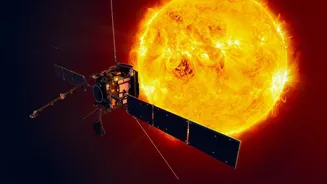
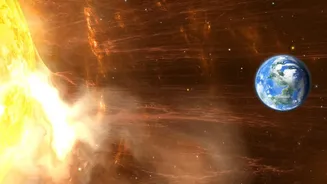
The focus of the new study, published in The Astrophysical Journal Letters, was a Coronal Mass Ejection (CME) that occurred on August 5, 2024. CMEs are colossal explosions of plasma and magnetic fields from the Sun's corona, its outermost atmosphere. For a long time, scientists have modelled these events as symmetrically expanding bubbles. However, observations from Aditya-L1 have challenged this assumption. By combining data from its Visible Emission Line Coronagraph (VELC) with images from a NASA satellite, researchers found that this particular CME expanded asymmetrically and had a tilted structure.
The Key Instrument: VELC
The breakthrough was made possible by the Visible Emission Line Coronagraph (VELC), Aditya-L1's primary instrument. Unlike typical imagers that only capture motion across the sky, VELC can also measure how fast plasma is moving toward or away from the observer. It does this by analysing the Doppler shift in light—similar to how an ambulance siren's pitch changes as it passes by. During the eruption, VELC detected plasma moving both towards and away from it simultaneously. A model of a simple, uniform bubble couldn't explain these observations, but a model of a tilted, unevenly expanding eruption was a perfect match.
Why an Uneven Shape Matters
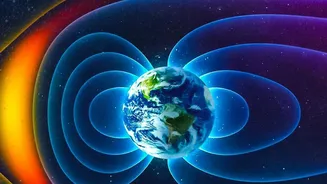
This discovery is more than just a cosmic curiosity; it has significant practical implications for predicting space weather. When a CME is directed towards Earth, it can trigger geomagnetic storms that disrupt satellites, GPS navigation, power grids, and communication networks. The shape of a CME is crucial because it affects how it travels through space. An asymmetric eruption will interact with the solar wind—the constant stream of particles from the Sun—differently than a symmetric one. This interaction can alter the CME's speed and trajectory, making it much harder to predict its arrival time and potential impact on Earth. By understanding that CMEs can be lopsided, scientists can build more accurate forecast models.
A New Era for Solar Science
This finding from Aditya-L1 marks a significant contribution by India to global solar physics. It showcases the mission's capability to provide unique, three-dimensional insights into solar phenomena from a single vantage point, a feat that previously required multiple spacecraft. Researchers at the Indian Institute of Astrophysics, who led the study, plan to apply this technique to other CMEs to confirm the findings and refine their models. Each new observation helps build a more complete picture of the Sun's behaviour, enhancing our ability to protect our technology-dependent world from its powerful outbursts. This initial discovery is a promising sign of the valuable data Aditya-L1 will continue to provide throughout its mission.