

The Slow Dance of Departure
It may sound like science fiction, but it's a well-measured reality: the Moon is moving away from Earth at a rate of about 3.8 centimetres per year. That's roughly the same speed at which your fingernails grow. This measurement has been confirmed with
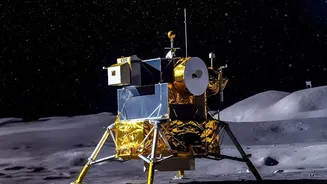
remarkable precision since the 1970s, using laser beams bounced off reflective panels left on the lunar surface by the Apollo missions. The reason for this gradual separation is a complex gravitational dance involving our planet's oceans. The Moon's gravity pulls on Earth's water, creating the familiar ocean tides. As Earth rotates faster than the Moon orbits, it drags these tidal bulges slightly ahead of the Moon. This forward-placed mass of water then gives the Moon a small gravitational tug, transferring rotational energy from the Earth into the Moon's orbit. This extra energy pushes the Moon into a higher, more distant orbit, causing it to slowly spiral away.
The End of an Astronomical Era
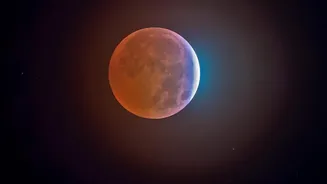
While 3.8 centimetres a year doesn't seem like much, over cosmic timescales it adds up. This increasing distance has a direct and fascinating consequence for us on Earth: the end of total solar eclipses. A total solar eclipse is a beautiful celestial coincidence. Currently, the Moon is at just the right distance for its apparent size in our sky to perfectly block out the Sun's disk. The Sun is about 400 times larger than the Moon, but it is also about 400 times farther away, making them appear almost the same size to us. But as the Moon drifts farther away, its apparent size will shrink. Eventually, it will become too small to completely cover the Sun. Scientists calculate that the last total solar eclipse visible from Earth will occur in approximately 600 million years. After that, future inhabitants of our planet will only ever see annular eclipses, where a 'ring of fire' remains visible around the Moon's silhouette.
A Longer Day for a Distant Moon
The energy transfer that pushes the Moon away must come from somewhere. That 'somewhere' is Earth's own rotation. By giving energy to the Moon, our planet is actually slowing its spin. This means our days are getting longer. The effect is minuscule, adding only about 1 to 2 milliseconds to the length of a day every century. But looking back through geological records, scientists can see the cumulative effect. A billion years ago, when the Moon was closer, an Earth day was only about 19 hours long. This process will continue as long as the Moon recedes. The farther it gets, the slower our planet will spin, and the longer our days will become. This profoundly slow change illustrates the powerful, interconnected nature of the Earth-Moon system, a relationship that has shaped our planet's very rhythm.
Forever Our Neighbor, Just Farther Away
So if the Moon is constantly moving away, will it eventually break free from Earth's gravity and drift off into space? The simple answer is no. The forces causing the Moon to recede weaken with distance. As the Moon gets farther away, its gravitational pull on Earth lessens, the tides become weaker, and the rate of recession slows down. Long before the Moon could ever escape, our solar system will face a much more dramatic event. In about 5 billion years, our Sun will expand into a red giant, likely engulfing and destroying both Earth and the Moon. But even if the Earth-Moon system were to somehow survive, it wouldn't result in separation. The system would eventually reach a stable state called a 'tidal lock', where the Earth's rotation slows to match the Moon's orbital period. At that point, the recession would stop, and our celestial companion would remain, as ever, gravitationally bound to us.