







What Did Aditya-L1 Observe?
Scientists using data from Aditya-L1 have identified small, short-lived brightenings in the Sun's atmosphere that occur hours before a major solar flare erupts. These tiny flashes cluster around the very spot where a powerful flare later explodes. The spacecraft's
instruments, operating in unison, have captured these precursor events in both ultraviolet and X-ray wavelengths, offering a more complete picture of the build-up to a solar eruption. In its first year, instruments also observed dozens of powerful X-class flares, providing a wealth of data on the Sun's most energetic outbursts. This ability to spot pre-flare activity is a crucial first step towards one of the mission's primary goals: predicting space weather.
A Quick Guide to Solar Flares
So, what exactly is a solar flare? Think of it as a gigantic explosion on the Sun's surface. These events happen when immense magnetic energy, often stored in the atmosphere above sunspots, is suddenly released. This release sends a burst of radiation hurtling through space. Flares are classified by their strength, much like earthquakes, with A-class being the weakest and X-class being the most powerful. While smaller C-class flares have few noticeable effects on Earth, major M-class and X-class flares can have serious consequences. They can disrupt radio communications, damage satellites, interfere with navigation systems like GPS, and pose a radiation risk to astronauts.
ISRO's Eyes on the Sun
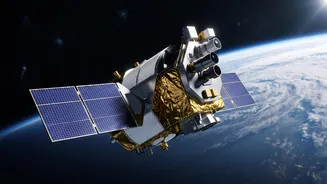
Aditya-L1 is equipped with seven advanced instruments, and this recent discovery was a team effort between three of them. The Solar Ultraviolet Imaging Telescope (SUIT) captures high-resolution images of the Sun’s lower atmosphere—the photosphere and chromosphere—in near-ultraviolet (NUV) wavelengths that are invisible from Earth. Complementing SUIT are two X-ray monitors: the Solar Low Energy X-ray Spectrometer (SoLEXS) and the High Energy L1 Orbiting X-ray Spectrometer (HEL1OS). Together, they watch for the high-energy signatures of a flare building in the Sun’s outer atmosphere, the corona. This allows scientists to connect activity in the lower atmosphere to the massive energy releases happening higher up.
Why These 'Early' Signals Are a Big Deal
Detecting these pre-flare brightenings is more than just a scientific curiosity; it's a critical step toward developing a reliable solar-flare forecasting system. By understanding the physical processes that trigger these massive explosions, scientists can improve space weather predictions. This isn't just about protecting astronauts. Our modern world is deeply reliant on technology that is vulnerable to severe space weather. An accurate forecast could give satellite operators, power grid managers, and airlines crucial lead time to take protective measures, mitigating potentially billions of dollars in damage and widespread disruption. These early findings demonstrate that Aditya-L1 is not just observing the Sun but is on its way to becoming a vital sentinel for Earth.
A Strategic Vantage Point
Aditya-L1's success is also due to its unique location. The spacecraft is positioned at Lagrange Point 1 (L1), a spot in space where the gravitational pulls of the Earth and the Sun balance each other out. This allows the probe to essentially hover, maintaining a constant, uninterrupted view of the Sun. Unlike ground-based telescopes or satellites in Earth's orbit, Aditya-L1 never has its view blocked by our planet, enabling it to monitor solar activity 24/7. This continuous observation is key to catching fleeting, subtle events like the pre-flare brightenings that might otherwise be missed. This vantage point, combined with its advanced instruments, makes Aditya-L1 a world-class solar observatory.