



The Challenge of Lunar Navigation
For decades, navigating in deep space has been a meticulous process completely reliant on Earth. Spacecraft have to constantly 'phone home' to giant antennas that form NASA's Deep Space Network (DSN). By tracking a spacecraft's signal, mission controllers
can calculate its position and trajectory. While incredibly precise, this method has its limits. The DSN is a shared resource, managing communications for dozens of missions across the solar system, creating a communications bottleneck. This reliance means missions can't make quick, independent decisions; every adjustment requires a conversation with Earth, a process that isn't ideal for the fast-paced, complex operations envisioned for a permanent lunar base.
A 'Lighthouse' on the Lunar Shore
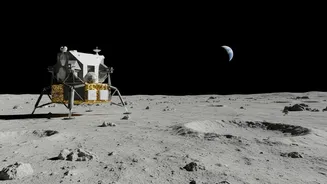
Enter the Lunar Node-1, or LN-1. This small, CubeSat-sized payload is essentially a navigation beacon designed to be the first 'lighthouse' for the Moon. Developed at NASA's Marshall Space Flight Center, the LN-1 was sent to the Moon as part of a commercial mission under the CLPS (Commercial Lunar Payload Services) initiative, hitching a ride on an Intuitive Machines lander. Its primary goal was to test a new method of autonomous navigation, one that doesn't need to constantly check in with Earth. By transmitting its own signal, LN-1 acts as a fixed reference point, a crucial first piece of a much larger puzzle.
How It Works: An Independent Network
The technology behind LN-1 is called the Multi-spacecraft Autonomous Positioning System (MAPS). Successfully tested on the International Space Station in 2018, MAPS is software that allows networked spacecraft to determine their positions relative to each other, without needing guidance from the ground. The LN-1 beacon transmitted its position information, which was monitored back on Earth to confirm the system worked as planned. Although the lander's final orientation limited the beacon's transmission time, the test was a success, proving the hardware and software could function in the harsh lunar environment. This demonstration opens the door for a network of similar beacons on the surface and in orbit, creating an interconnected system.
The Power of True Autonomy
The real prize here isn't just navigation, but autonomy. An independent lunar network, dubbed LunaNet by NASA, will function much like the internet and GPS on Earth. It would allow astronauts, rovers, and landers to know their precise location in real-time. This enables far more complex missions. Astronauts could explore treacherous craters knowing their exact position relative to their lander, and robotic rovers could navigate rugged terrain on their own. It also makes lunar operations more resilient; if contact with Earth is temporarily lost, missions can continue to operate safely. This capability is essential for building a sustainable, long-term human presence on the Moon as envisioned by the Artemis program.
Paving the Way for Artemis and Beyond
The LN-1 is a foundational piece of infrastructure for Artemis, NASA's campaign to establish a permanent base on the Moon. This future lunar hub will require a flurry of activity, with multiple landers, rovers, and orbiting spacecraft operating simultaneously. A LunaNet architecture will allow these assets to coordinate and navigate safely and efficiently. It will create a framework that commercial and international partners can also use, fostering a collaborative lunar ecosystem. As NASA and its partners, including the European and Japanese space agencies, refine this technology, they are not just building a GPS for the Moon; they are creating the blueprint for the communications and navigation networks that will one day guide humans to Mars and beyond.