






A World More Active Than Imagined
When NASA's New Horizons spacecraft flew past Pluto in 2015, it completely rewrote our understanding of this remote world. Instead of a static ball of ice, the images revealed towering water-ice mountains, vast plains, and a stunning lack of impact craters
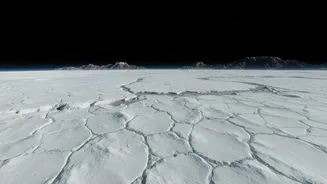
in certain areas. The most iconic of these features is Tombaugh Regio, nicknamed Pluto's heart. The western lobe of this heart, a massive basin called Sputnik Planitia, is a colossal glacier of frozen nitrogen larger than Texas and Oklahoma combined. The smooth, unblemished surface of this glacier was a dead giveaway to scientists that it is geologically young and active, constantly renewing itself over millions of years through slow-moving convection currents in the ice.
The Dark Streaks Mystery
High-resolution images of the northern part of Sputnik Planitia revealed another puzzle: a network of dark, linear streaks and more diffuse patches lining the boundaries of the glacier's city-sized convection cells. A new study, published in the Planetary Science Journal, proposes a fascinating explanation for these features. Researchers led by the Southwest Research Institute (SwRI) argue that these dark areas have been wetted by liquid. But since Pluto's frigid temperatures and thin atmosphere make liquid nitrogen rain impossible, the liquid must be coming from somewhere else: below the surface.
A Subsurface Plumbing System
The new theory, based on computer models, suggests that deep beneath Sputnik Planitia's kilometers-thick nitrogen ice sheet, conditions are right for melting. While the surface is incredibly cold, heat from Pluto's rocky core, likely from the decay of radioactive elements, could be just enough to melt the base of the glacier. This creates pockets of liquid nitrogen. According to the models, this liquid nitrogen, being less dense than the solid ice above it, would become buoyant. It would then be forced upwards through cracks and conduits, much like magma rising through fissures in Earth's crust. The researchers suggest these eruptions would need to be short, intense pulses to account for the observed surface features.
Flash-Frozen Geysers
Upon reaching the intensely cold surface, this liquid nitrogen would erupt like a geyser. However, it would only remain liquid for a very brief time before flash-freezing and flowing down slopes, wetting the ground and leaving behind the dark patterns seen by New Horizons. Scientists drew comparisons to features on Earth's own Greenland ice sheet, where the emergence of subsurface liquid water darkens the snow and ice in a similar way. This process provides the first evidence that liquid may have recently flowed on Pluto's surface, a stunning revelation for a world so far from the Sun. The surface of Sputnik Planitia is estimated to be less than a million years old, meaning these features must have formed within that geologically recent timeframe.
Implications for Icy Worlds
This discovery reshapes our view of Pluto as a geologically active world. It suggests that even in the solar system's coldest corners, internal heat can drive dynamic processes like cryovolcanism—volcanoes that erupt ice and other volatiles instead of molten rock. This mechanism could also help explain similar mysterious features elsewhere in the outer solar system, such as the geysers observed on Neptune's moon Triton by the Voyager 2 spacecraft. It reinforces the idea that you don't need to be a large planet close to a star to be geologically alive. For a world once dismissed as a planetary footnote, Pluto is proving to be one of the most intriguing and complex bodies in our celestial neighbourhood.